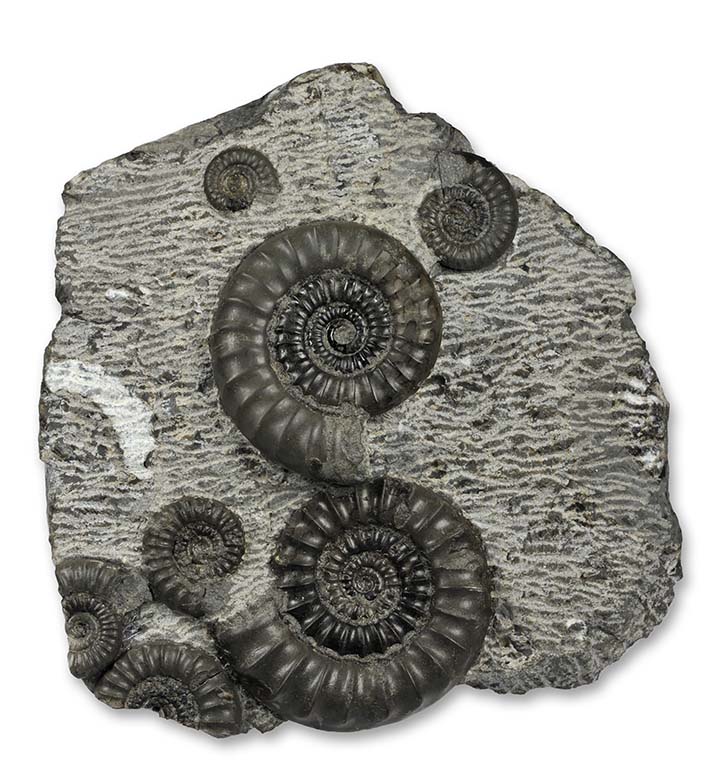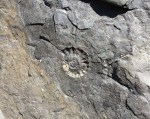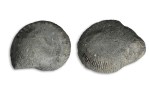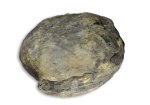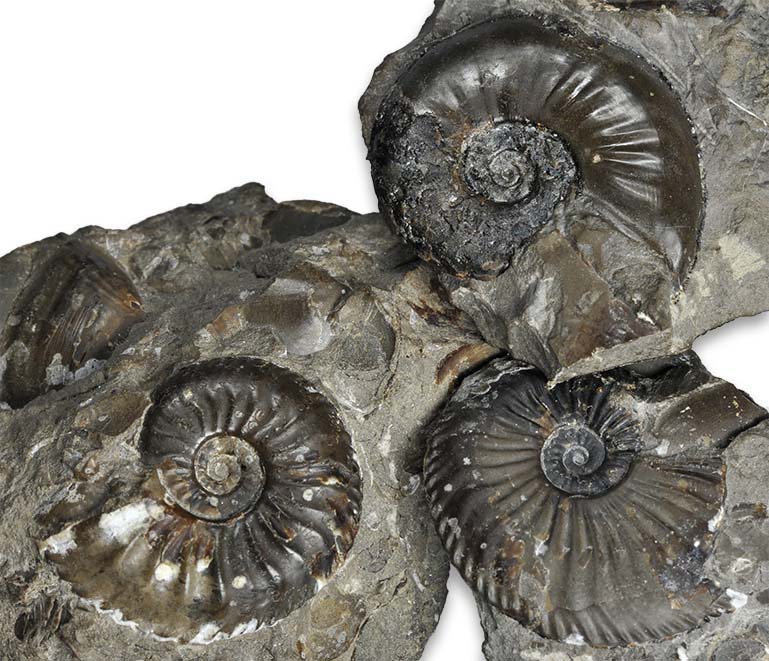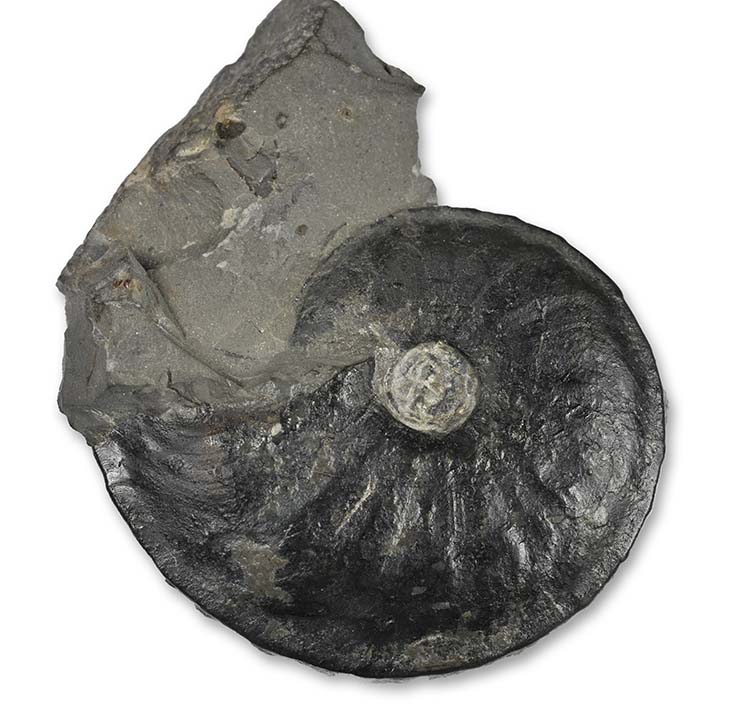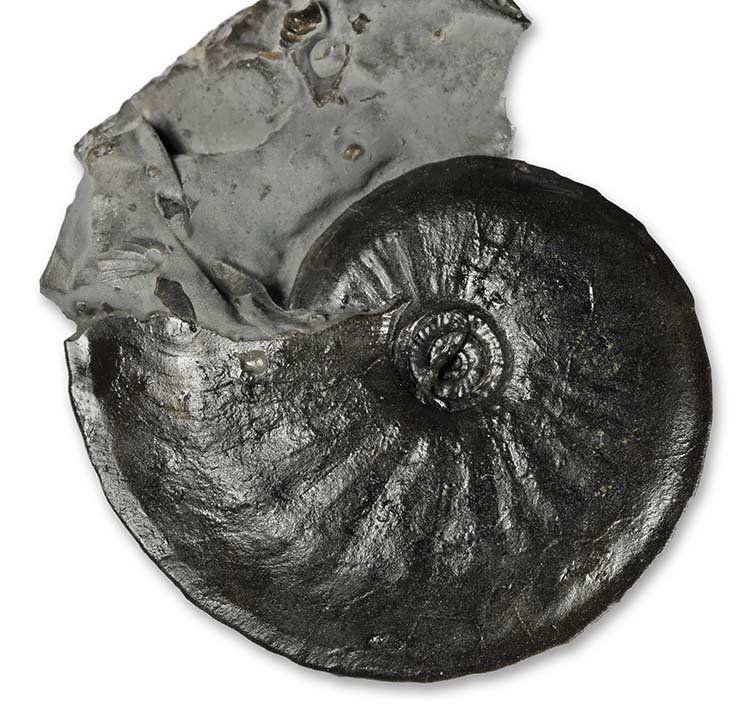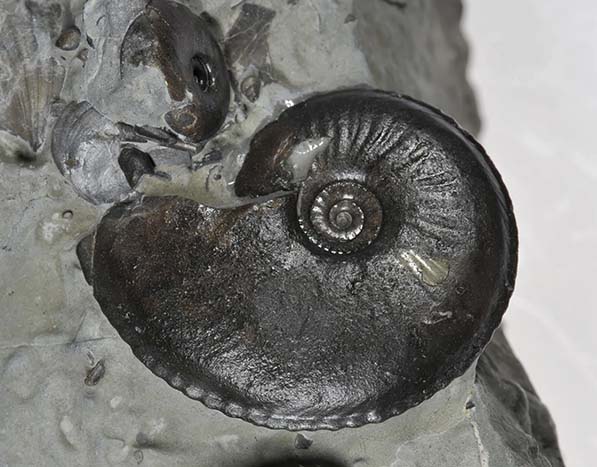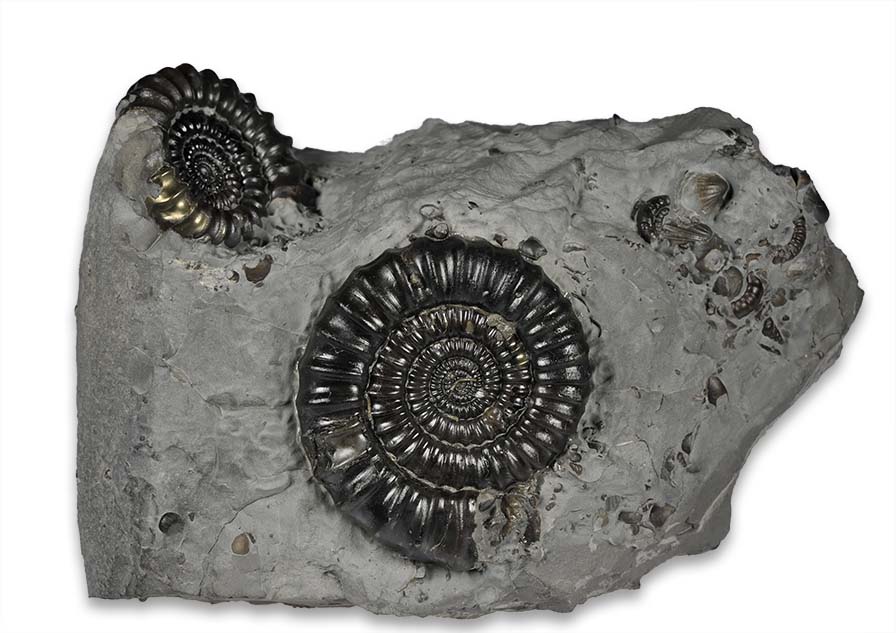
Gagaticeras or “…ribs like rows of jet beads”

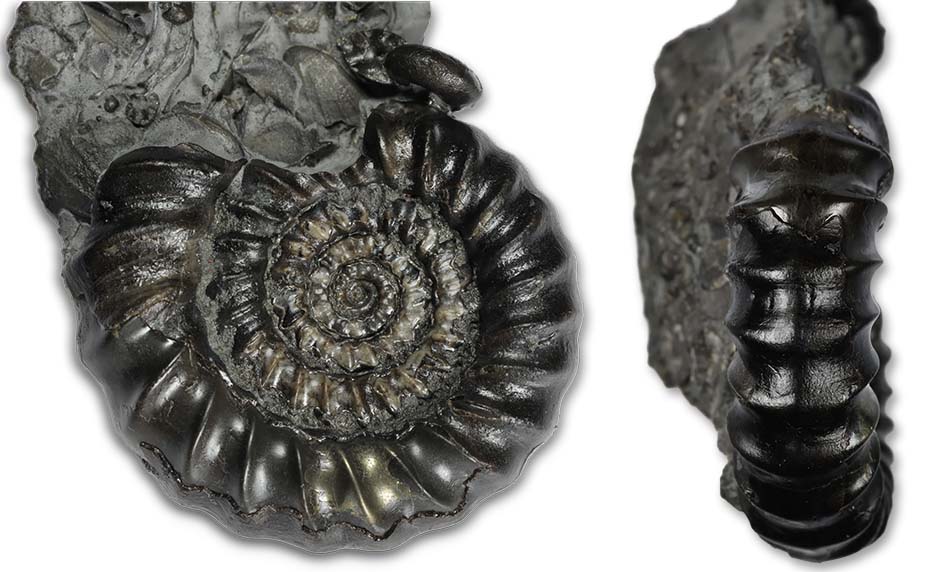
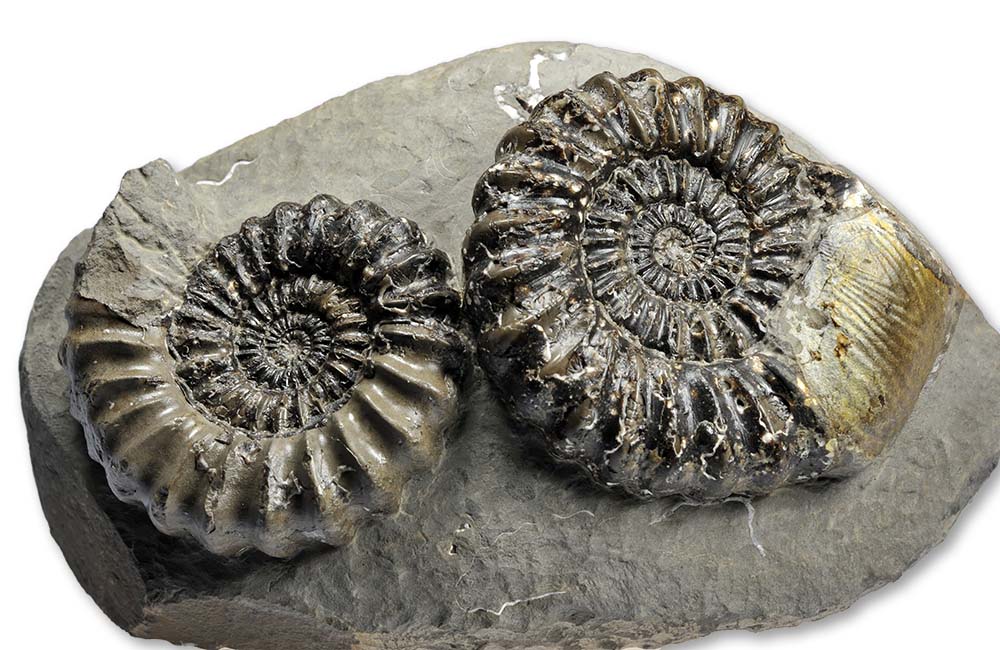
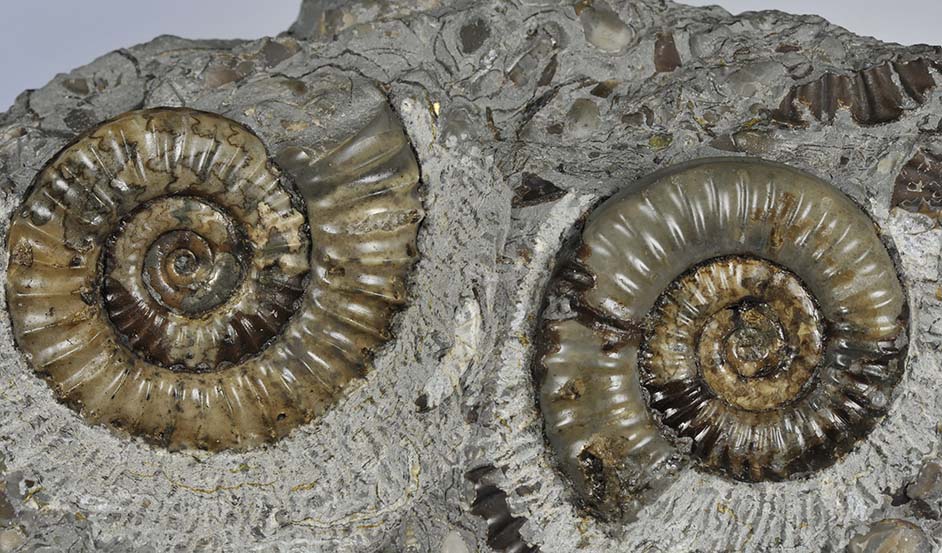
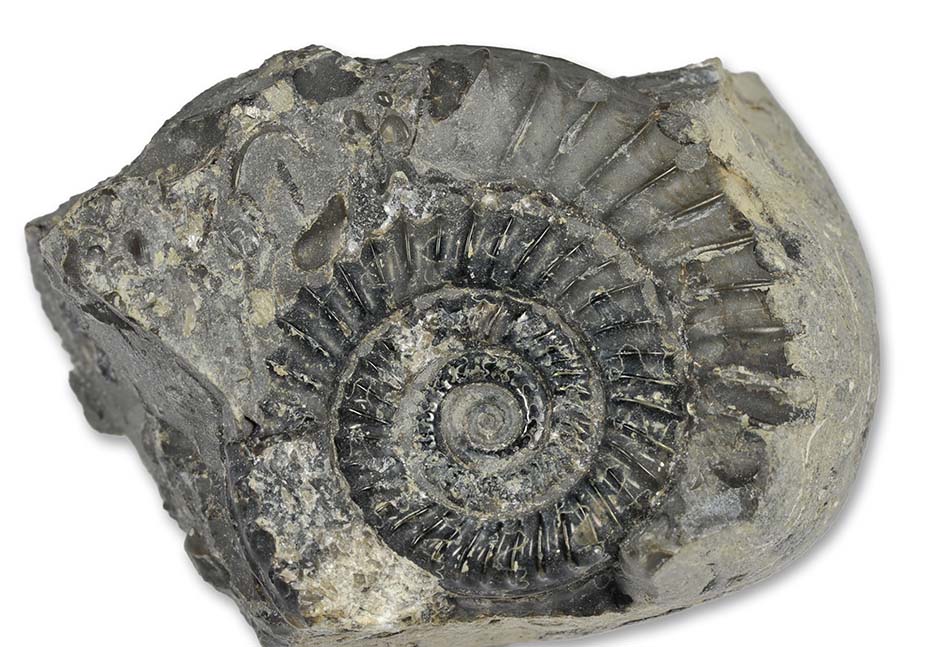
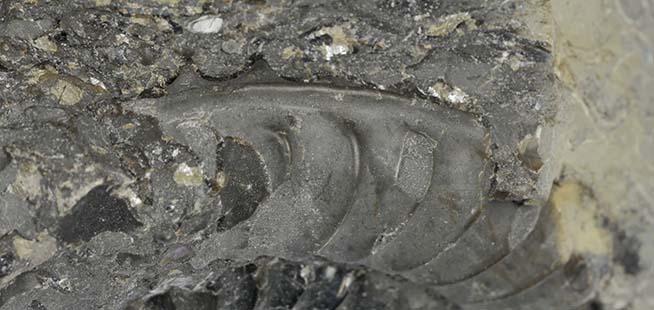
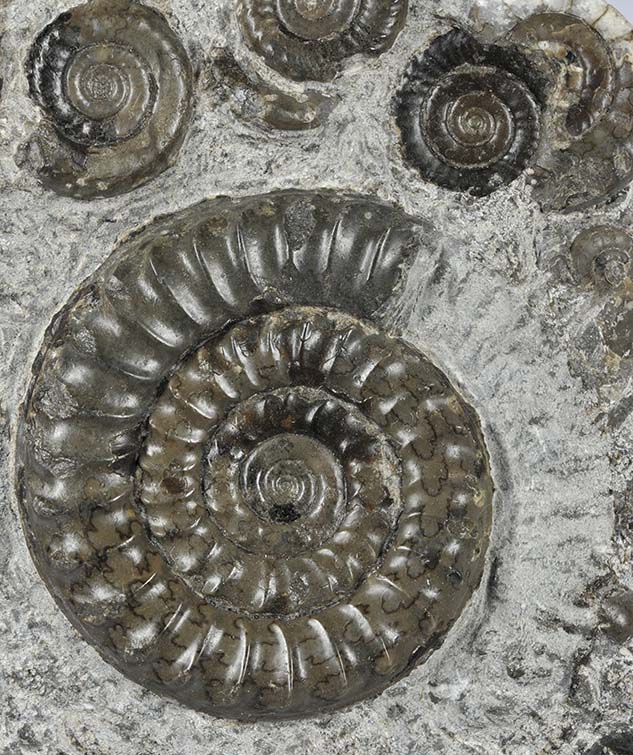
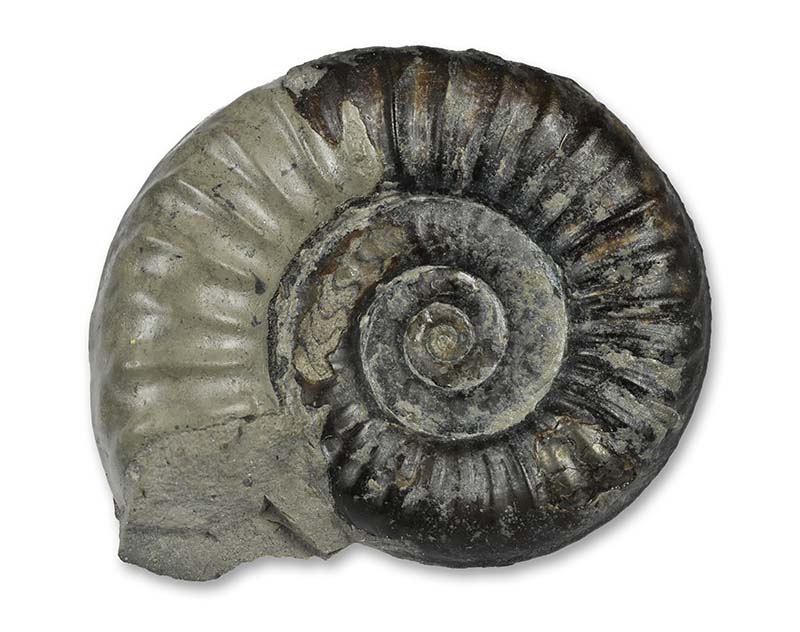
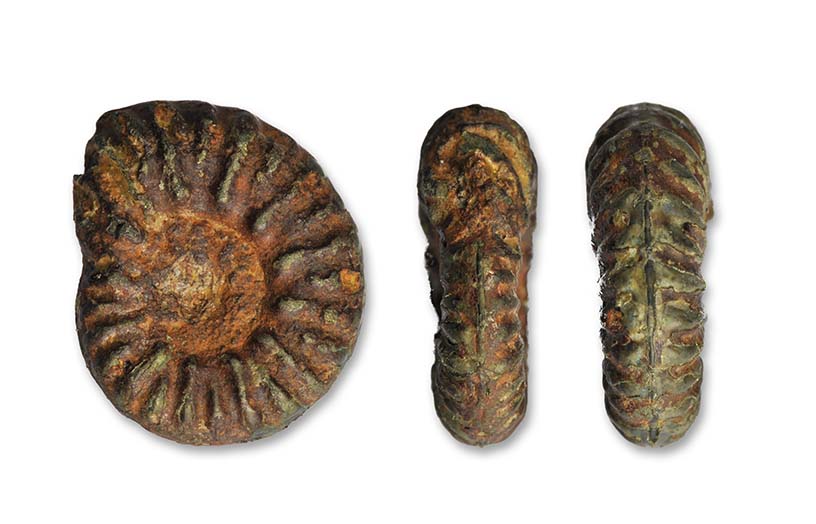
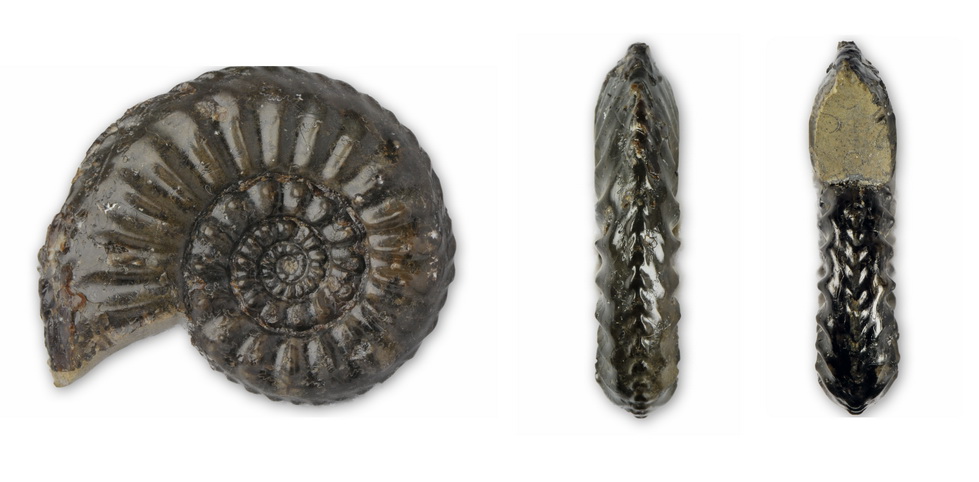
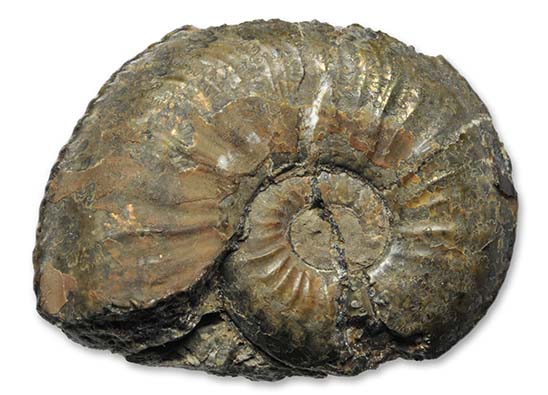
Gagaticeras cf. finitimum, 5 cm

Gagaticeras cf. finitimum, 5 cm

Gagaticeras in my mind somehow is more of a coincidental find, casually picked up on the way somewhere else – which of course does not do this fine ammonite genus any justice.Around Robin Hoods Bay it has been reasonably common in the last couple of years (though I´ve noticed a drop in the last 2-3 years), I´ve mostly found them almost eroded free or in nodules that were thrown onto the beach during storms, the beds they occur in are very often sanded over – since most of the coast is a SSSI you´re not really supposed to do any large-scale digging in them anyway.

As you start collecting Gagaticeras ammonites, at first sight they mostly look the same (especially in the field), you put them in the drawer as “Gagaticeras gagateum”.
You collect some more, clean them up as good as you can (they´re not easy to prep well because of their delicate inner whorls), put them in the drawer.

After a while, when looking into the drawer at what you´ve accumulated over the years, you begin to wonder and see little differences, a more pronounced keel here, rursiradiate ribbing there, differences in rib density etc.  A while ago after I acquired an air abrader, a re-preparation helped to work out some more details in the inner whorls.

When starting to document the Gagaticeras species for the book, I was really surprised (and pleased of course 🙂 )to see that I do actually have the four species that HOWARTH mentions in his Robin Hoods Bay / Bairstow collection paper !  I must admit though that it did take me some time to find the most characteristic specimen
for each species, there seem to be many intermediates (like the one pictured above, which has a very high rib density but almost no keel and no rib angle at the venter), which all the authors that have recently written about them (HOWARTH 2002, SCHLEGELMILCH 1976, GETTY 1973,…) have taken as a sign that intra-species variation may make it appear that there are more species than there really are – but that´s always the problem when you do not have a large enough collection to do statistical tests.

Here they are :

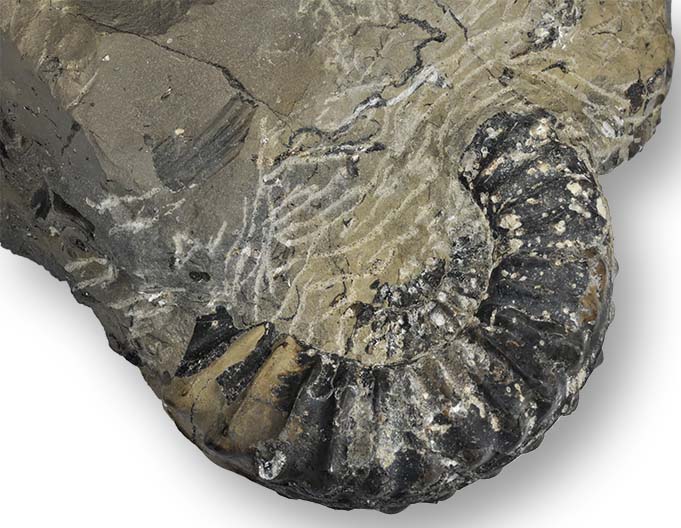
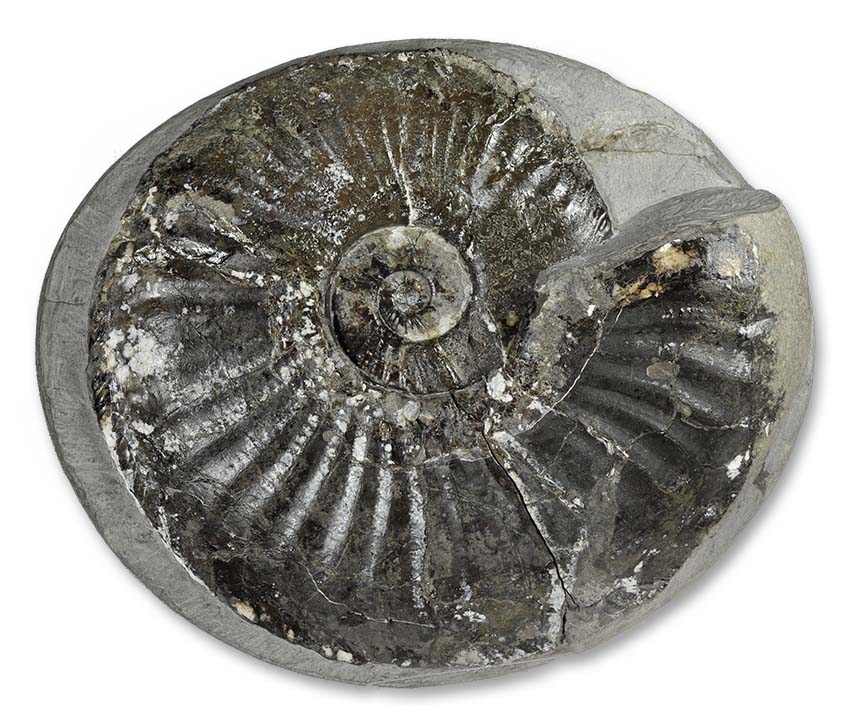
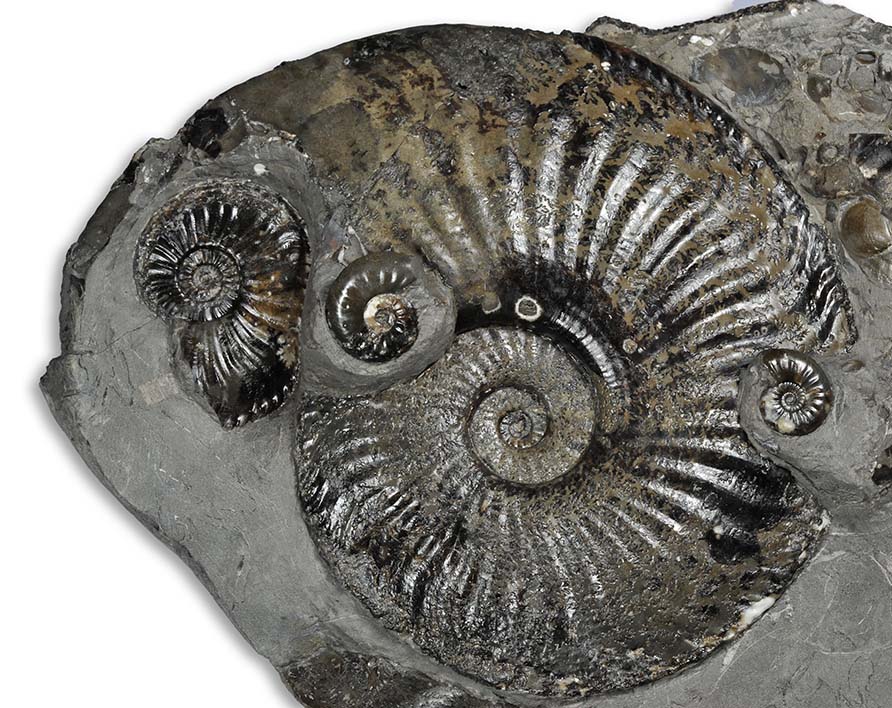
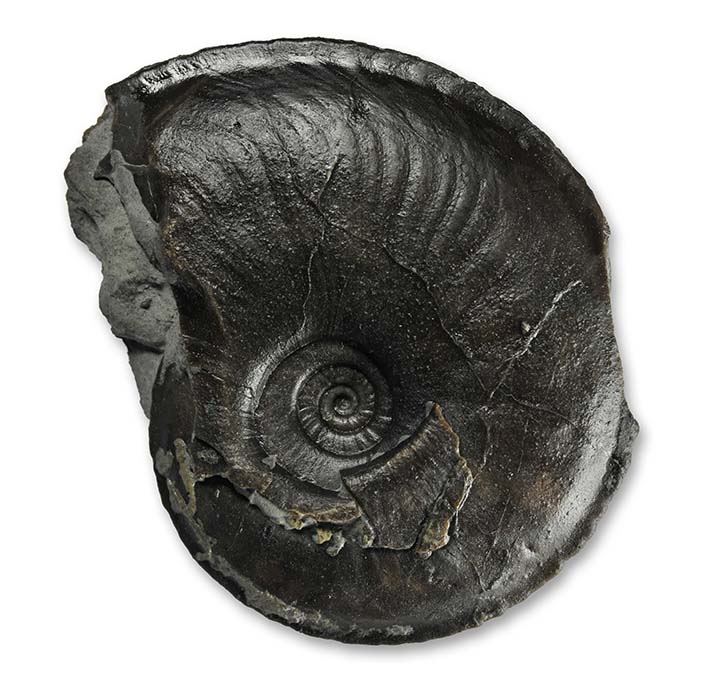
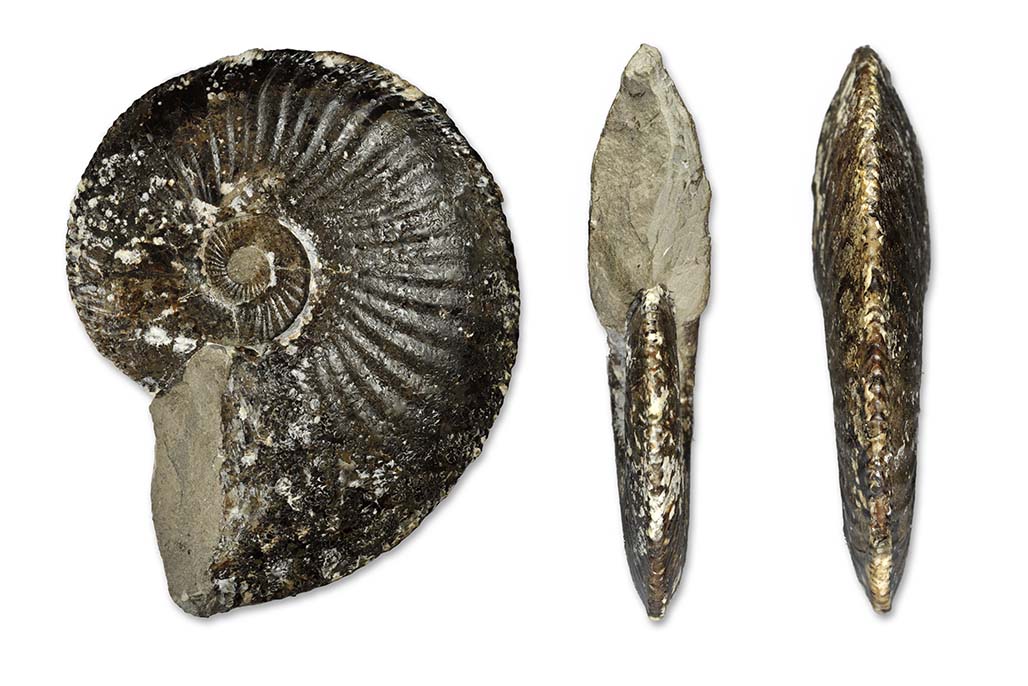
Gagaticeras gagateum (YOUNG & BIRD, 1828)
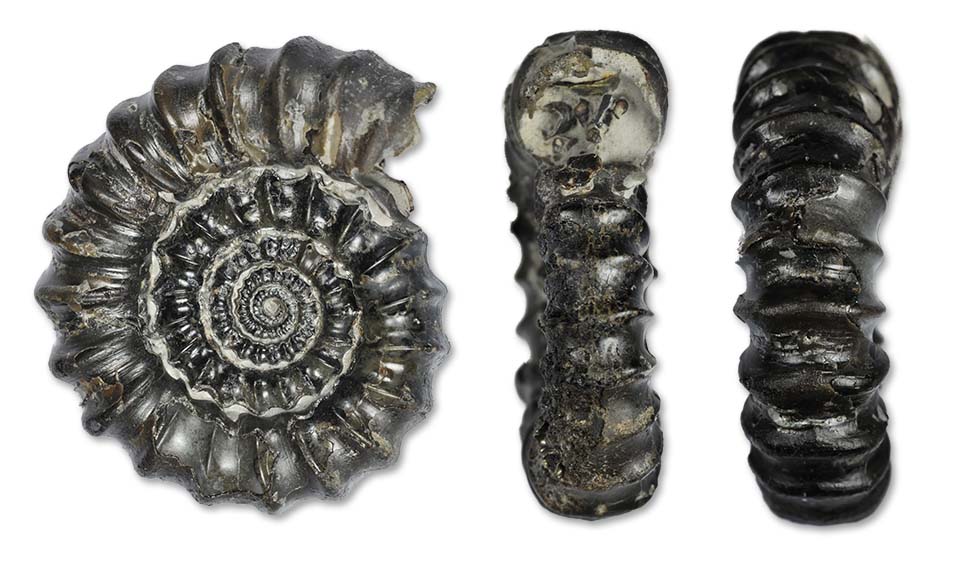
 

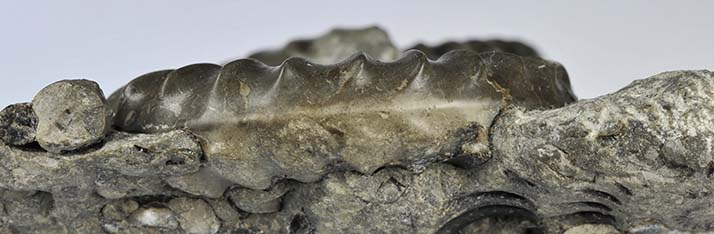
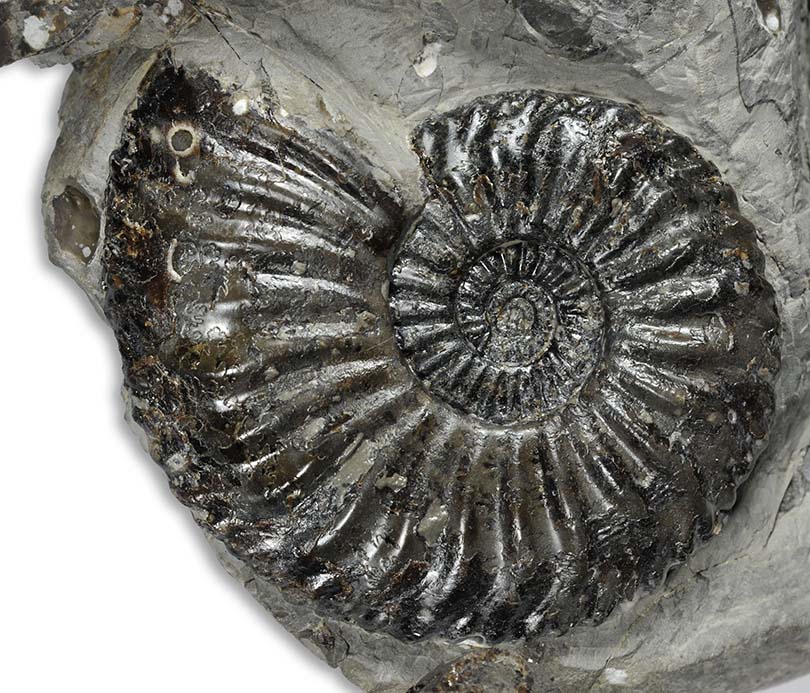
Gagaticeras gagateum, 3.5 cm, with aperture & keel view

Gagaticeras gagateum, 3.5 cm, with aperture & keel view

G. gagateum has a rib density of 20 – 24 ribs / whorl, but there is only the slightest hint of a keel on the venter, sometimes completely invisible.
Whorl section is more compressed than on the other species, i.e. the whorl is thicker than high.

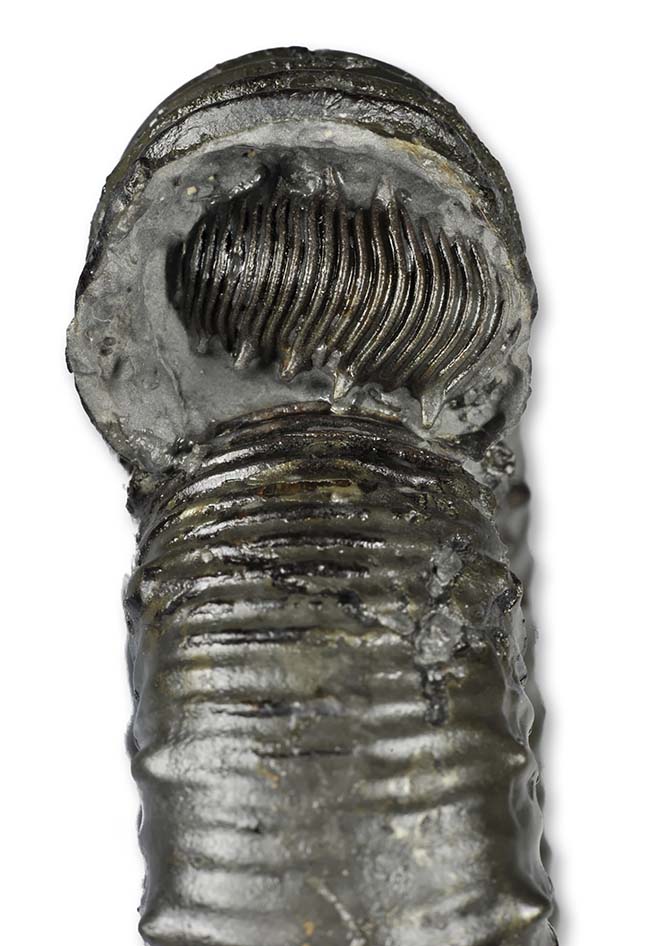
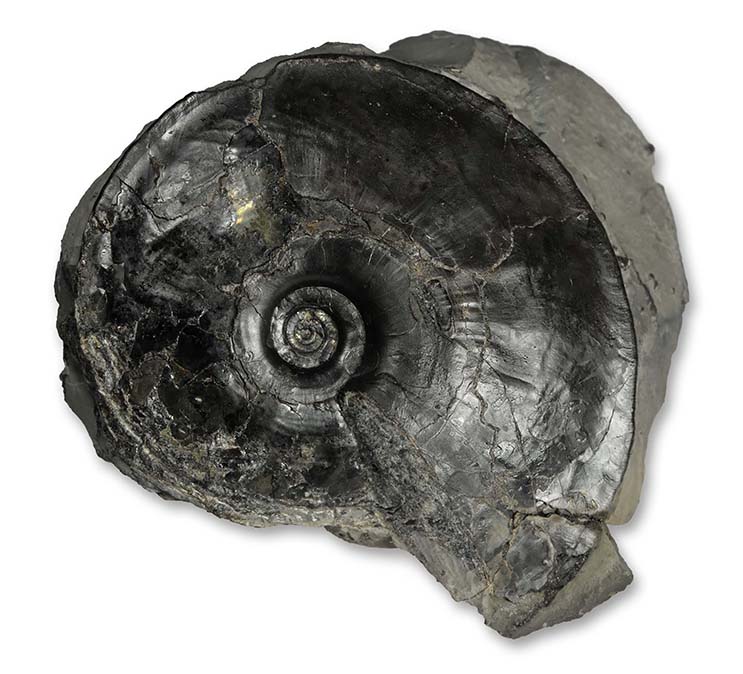
Gagaticeras neglectum (SIMPSON, 1855)
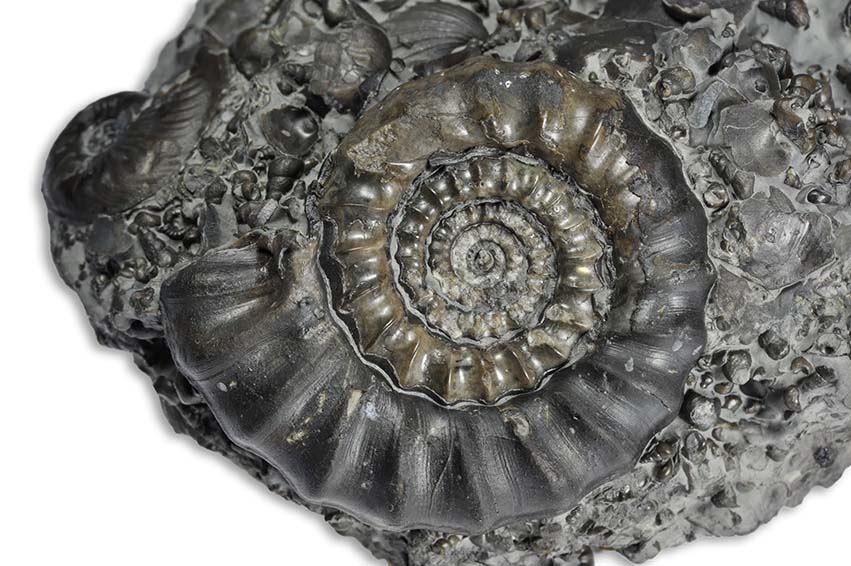
 

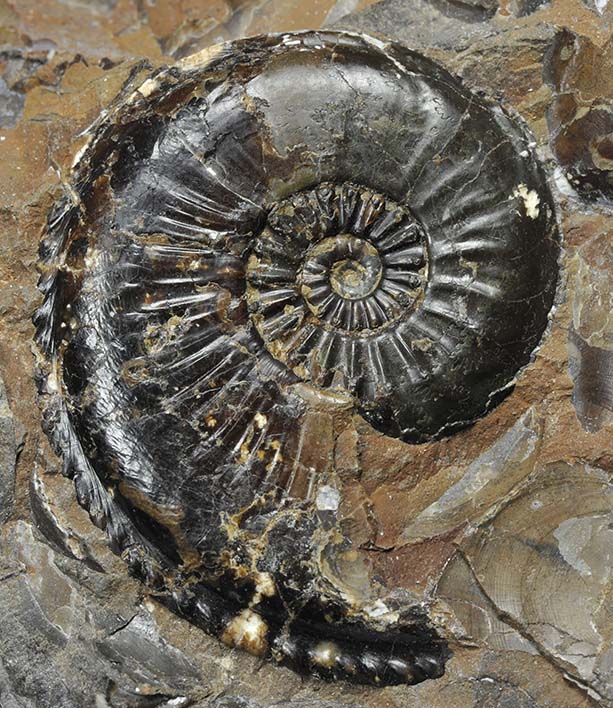
Gagaticeras neglectum, 4 cm
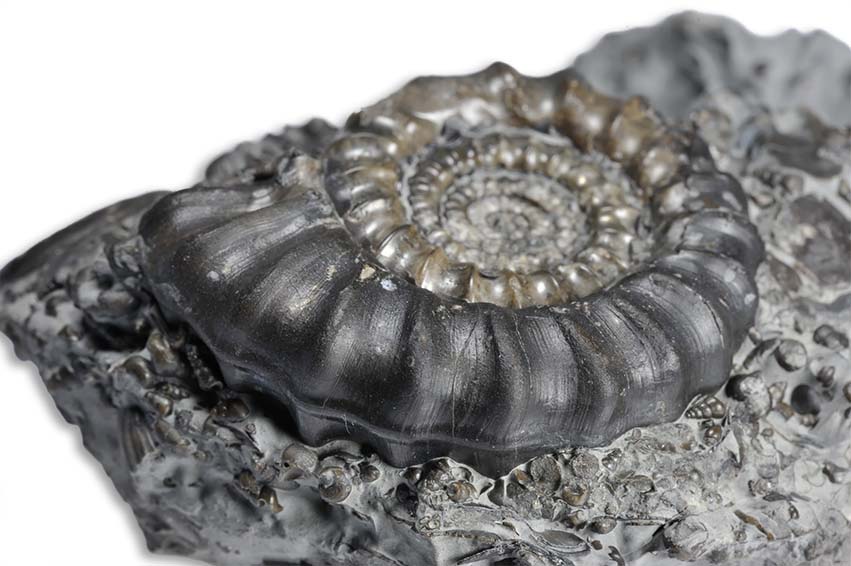
Gagaticeras neglectum, 4 cm

Gagaticeras neglectum, 4 cm, keel view

Gagaticeras neglectum, 4 cm, keel view

G. neglectum has a rib density of about 20 ribs / whorl, but there is a (sometimes strong) keel on the venter. Whorl section compare to G. gagateum
is less depressed, almost round. The expression of the keel seems to be very variable.

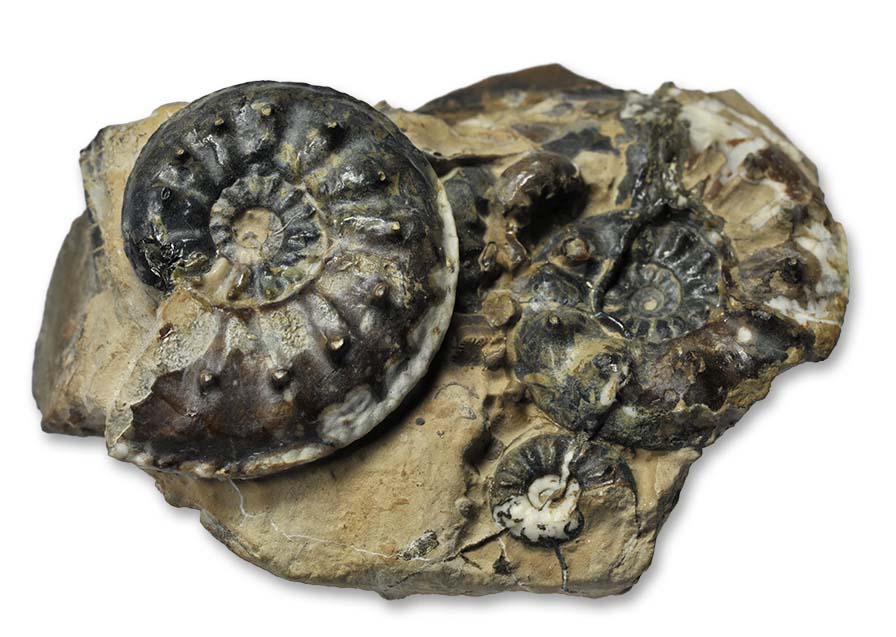
Gagaticeras finitimum (BLAKE, 1876)
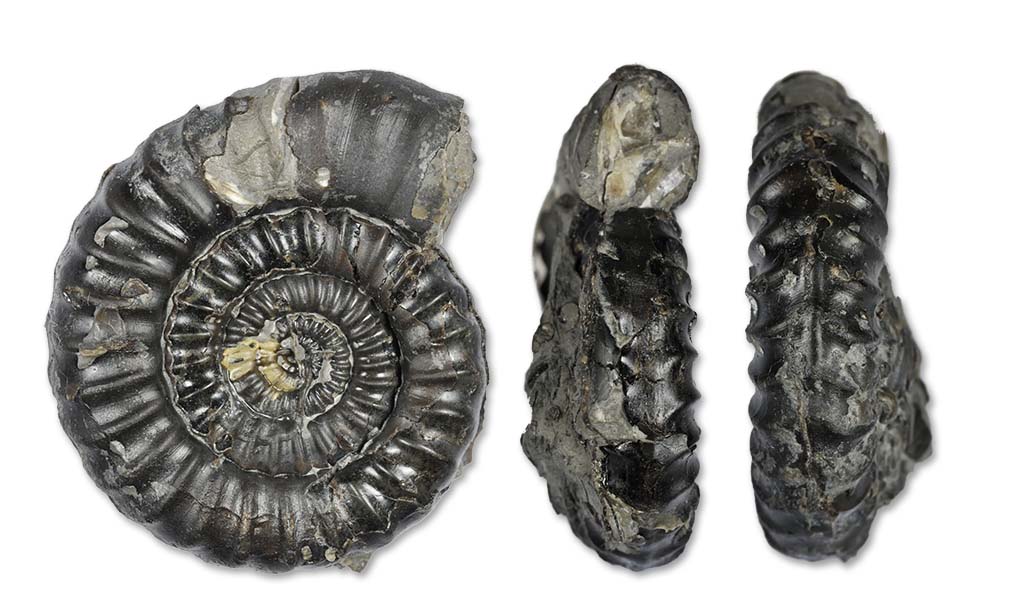
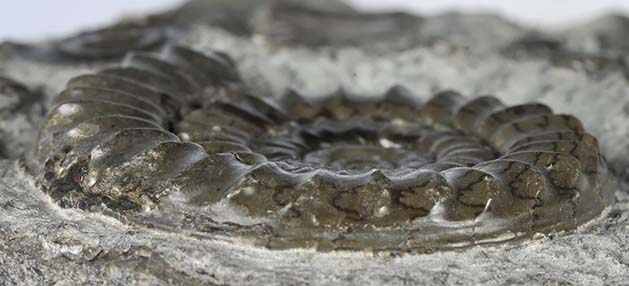
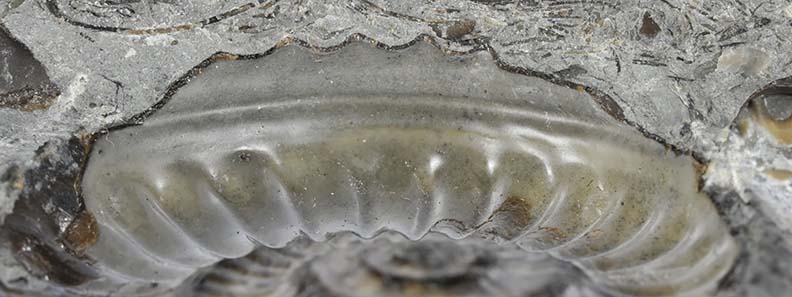
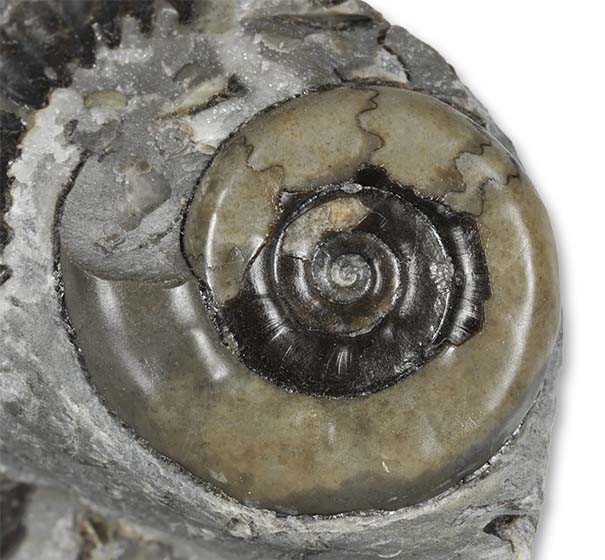
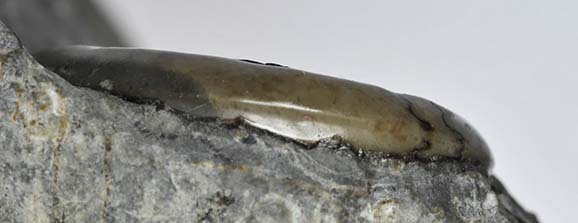
Gagaticeras finitimum, 3.7 cm, with aperture & keel view

Gagaticeras finitimum, 3.7 cm, with aperture & keel view

G. finitimum has the highest rib density (between 24 and 28 ribs per whorl) and the ribs meet at an angle at the venter.
Similarly to G. neglectum, there is a keel on the venter.

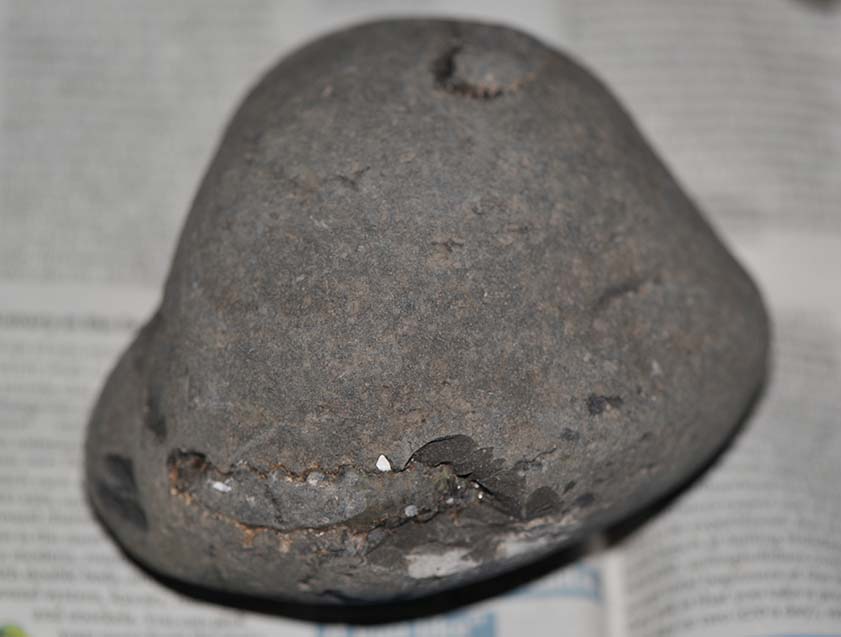
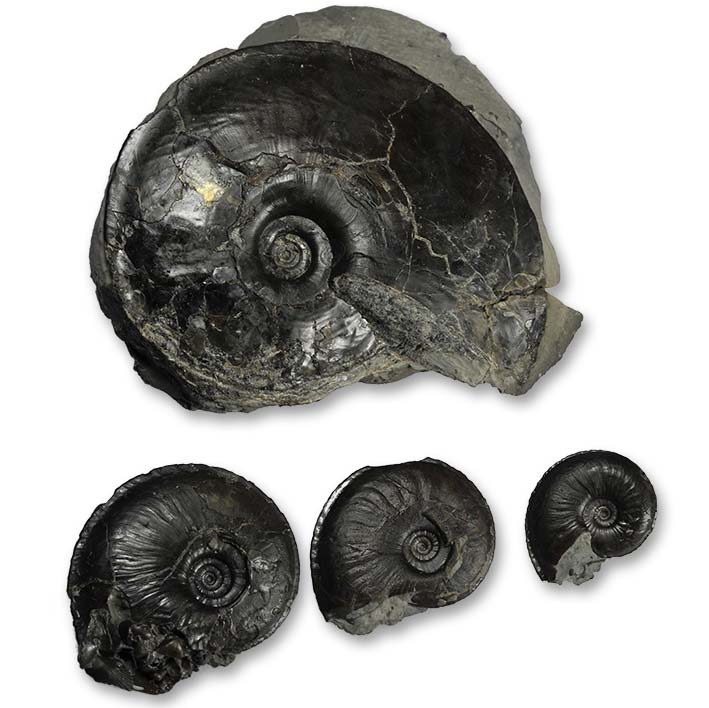
Gagaticeras exortum (SIMPSON, 1855)

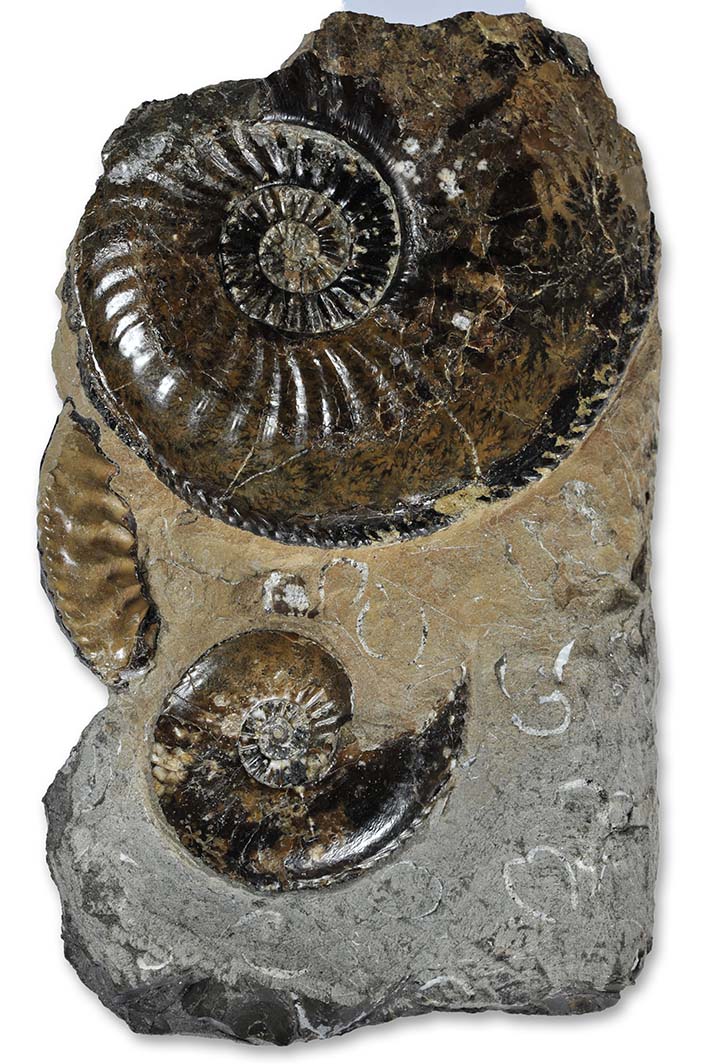
Gagaticeras exortum, 3 cm, with keel with

Gagaticeras exortum, 3 cm, with keel with

G. exortum is the easiest to identify : Ribs are quite rursiradiate (leaning backwards), there is just a hint of a keel.
If my collection were considered representative, it would be the rarest species of the four. Rib density on the figured specimen is
23 ribs / whorl at 30 mm diameter, another specimen I´ve seen has 26 ribs/whorl at 50 mm diameter.

In case you´re wondering what this all has to do with jet beads ?
Well, “gagateus” is the greek name for jet and the citation in this post´s title is from YOUNG & BIRD´s original 1828 description of “Ammonites gagateus”
and simply refers to similarity of the black whorls with jet beads…
AndyS

Disappointments, delights and a small surprise

You might have guessed, I’m currently spending some time prepping the finds from my last Yorkshire visit…

Here are a few updates on the fossils I’ve found and their prep status :
Lytoceras, no inner whorl :(

Lytoceras, no inner whorl 😦

The lower lias Lytoceras has become a disappointment,  as I was working around the whorl towards the inside of the nodule, several gaps in the shell appeared, where the whorl had broken apart, probably during the process of the fossilization.  The outermost part of the whorl is squashed, as I was “digging” for the inner whorls, nothing was there…
This is not unusual for luridum subzone Lytoceras, but they can be found with inner whorls preserved, as shown in the next picture of a specimen found ex-situ during another visit:
Lytoceras fimbriatum, 12 cm, with inner whorl :)

Lytoceras fimbriatum, 12 cm, with inner whorl 🙂

The Pleuroceras I´ve shown you earlier also  has become a disappointment after a promising start – there´s a big hole (more like half the whorl missing) in the outer whorl, the inner whorl is there, but it´s brittle Calcite. Oh well, another one for the graveyard of failed prep attempts aka the gravel patch beside our house…
Pleuroceras, whorl stops :(

Pleuroceras, whorl stops 😦

But there have also been delights and a small surprise…
An upper toarcian Ammonite that had recently fallen from the cliff and was just covered by a thin layer of soft mudstone went  directly to the air abrader, details that are usually lost when they roll around in the waves (or when they are embedded in hard mudstone nodules)  could be recovered, like the wonderful complete spines or this especially delightful small spiny Peronoceras (fragment ?) inside the aperture of the larger Peronoceras subarmatum.
Catacoeloceras subarmatum, 7 cm

Peronoceras  subarmatum, 7 cm

Aperture of the Catacoeloceras, with another small Catacoeloceras fragment inside

Aperture of the Catacoeloceras, with another small Catacoeloceras fragment inside

With some fossils, they may not look like anything when found but can yield surprises :
Peronoceras turriculatum, as found

Peronoceras turriculatum, as found

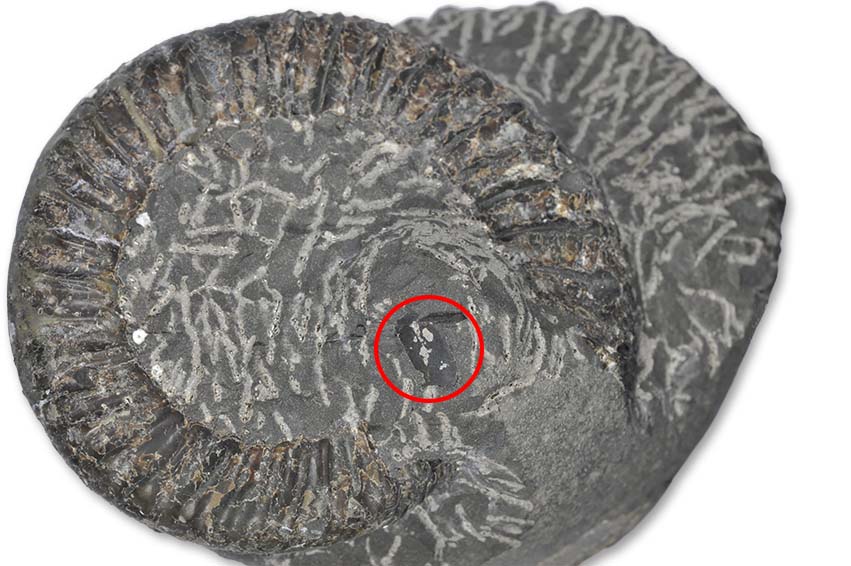
While roughing this Peronoceras turriculatum from the nodule, I noticed a small shelly fossil appearing after a matrix piece of about 1 x 1 cm size was dislodged by the airpen.  I stopped the airpen to take a closer look :
Peronoceras turriculatum, during preparation

Peronoceras turriculatum, during preparation

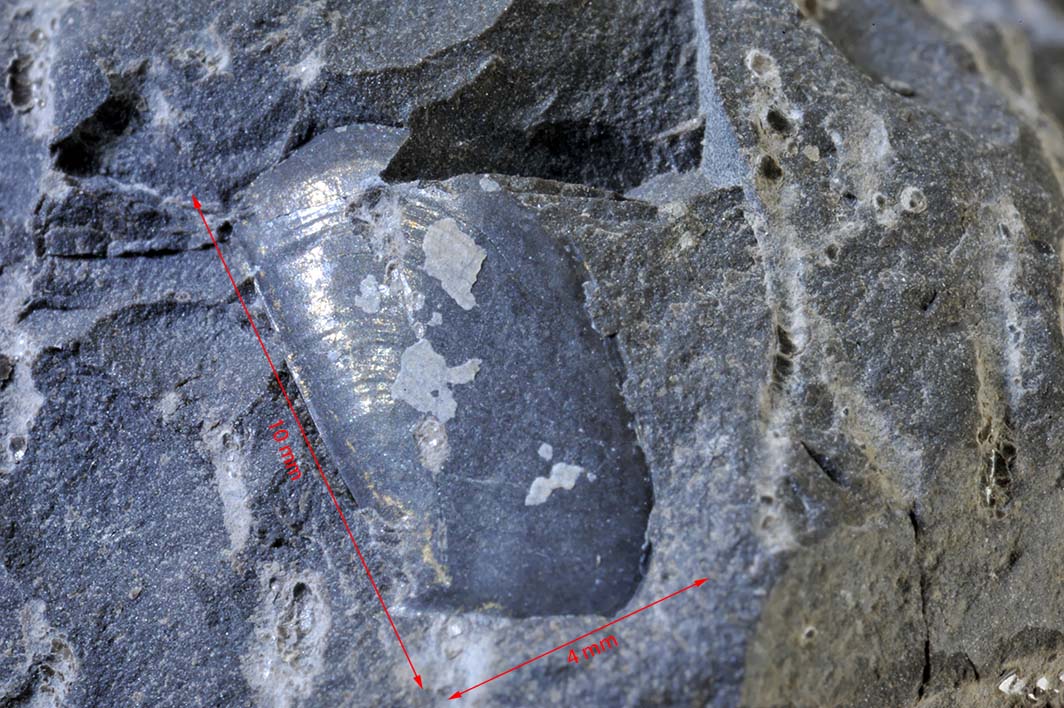
It’s a small aptychus, part of the ammonites jaw apparatus !
Apytchus inner mould, 10 x 7 mm

Apytchus inner mould, 10 x 4 mm

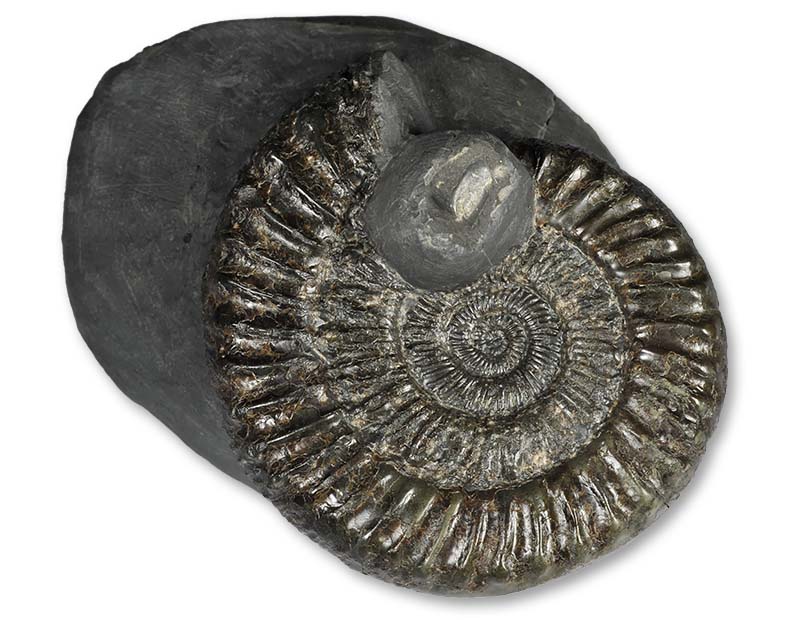
Since it is not inside the shell of the ammonite, it can not be safely concluded that it belongs to the ammonite, but form and size (may be a bit on the small side) seem about right, and it’s at least close to the aperture of the Peronoceras…
Peronoceras turriculatum, 7.5 cm, with aptychus

Peronoceras turriculatum, 7.5 cm, with aptychus

There is very little literature about Dactylioceratid aptychi, the only article I found is by Ulrich Lehmann describing remains of the jaw apparatus inside a Dactylioceras tenuicostatum
(Palaeonology Vol. 22, part 1, pages 265-271). He does notice that the jaw apparatus that was found inside that Dactylioceras was also smaller than expected.
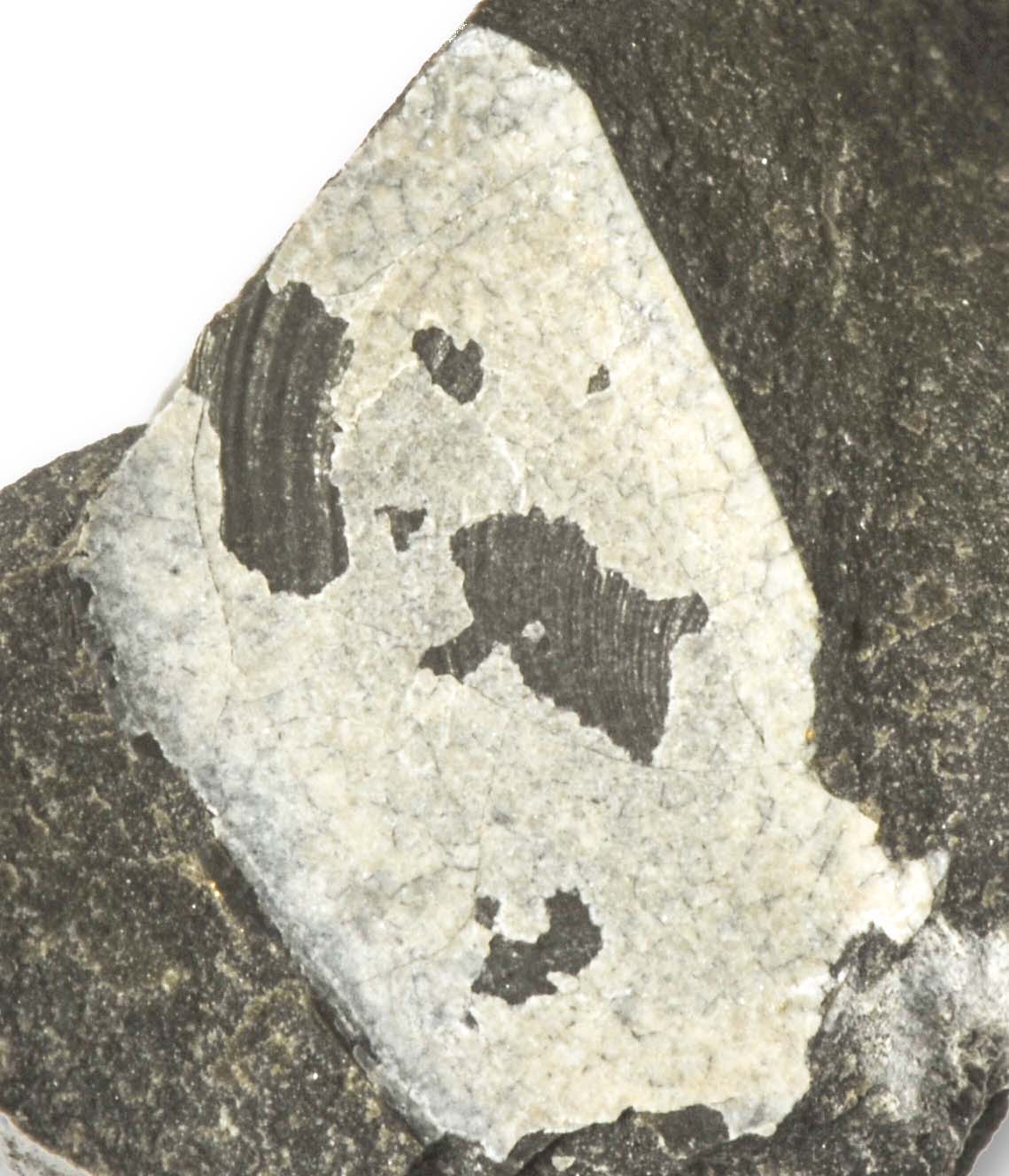
Inside my prep box I then went looking for the bit of matrix that flew away (I did not see where it landed) because it took with it most of the actual shell of the aptychus. This was about half an hour after I started work on the Peronoceras and my prep box was filled with hundreds if not thousands of similar matrix shreds… While contemplating the time it would take going through the splinters one by one I picked up a few likely looking ones and after about 5 pieces I found it –  you have to lucky sometimes  !
Apytchus shell, 9 x 7 mm

Aptychus shell, 9 x 7 mm

This has been tweaked somewhat in Photoshop to better show the structure of the aptychus – the colors are not 100% exact.
In my experience, every time I come to Yorkshire to collect I usually get to take with me one special piece – this time, it´s got to be the ammonite with the aptychus !
And, as a little bonus, since this is my 30th post, here is one of the highlights of  the previous visit in April : A double Androgynoceras lataecosta, 6 & 7 cm –
what makes this one special is a Goniomya bivalve which with its v-shaped ornament sits decoratively on the whorl of the ammonite…
Androgynoceras lataecosta, 6 & 7 cm, with Goniomya bivalve

Androgynoceras lataecosta, 6 & 7 cm, with Goniomya bivalve

AndyS

Arnioceras or A frustratingly sticky matrix

Arnioceras semicostatum, 4 & 4.5 cm, Holderness Coast

Arnioceras semicostatum, 4 & 4.5 cm, Holderness Coast

I must admit in my more than 20 years of collecting on the Yorkshire  coast I have not really had much luck with finding Arnioceras or with prepping it. When I see beautiful large slabs of Arnioceras, skillfully  prepared, I’m often somewhat frustrated with my own feeble attempts of prepping this sort of matrix from Robin Hoods Bay, where I most often collect. Another german collector once told me that Arnioceras material from the glacial drift (e.g. Holderness coast) does seem to prep easier, with the matrix being less “sticky”, may be due to longer weathering. So while I do still have some slabs of Arnioceras blocks found in Robin Hoods Bay waiting to be prepped in my cellar, most of the better pieces shown here are actually purchased from other collectors and orginating from the Holderness coast. Maybe I should give my slabs a few years of additional weathering in the garden…
To really see the differences between the Arnioceras species you need to look closely :
Arnioceras acuticarinatum, 4 cm, Robin Hoods Bay

Arnioceras acuticarinatum, 4 cm, Robin Hoods Bay

Arnioceras acuticarinatum, keel view

Arnioceras acuticarinatum, keel view

Arnioceras acuticarinatum is the easiest of the lot to identify. It has rursiradiate ribs, i.e. when you look at the whorl of an ammonite with the aperture to the right, you see that the ribs while going over the flank from umbilicus to venter point away from the aperture, they´re leaning backward towards the venter. It has quite an “acute”  (sharp, well-developed) keel as one might translate the latin species name. The partial one shown is actually found by myself, but I do have pictures of better specimen from other collections for the book…
Arnioceras kridioides, 3.5 & 4 cm, Holderness Coast

Arnioceras kridioides, 3.5 & 4 cm, Holderness Coast

Arnioceras kridioides, keel view

Arnioceras kridioides, keel view

Arnioceras kridioides in contrast has no pronounced keel and a very short stadium without ribs on the inner whorls. Keel wise it’s almost like a Gagaticeras.
Arnioceras falcaries, 4.5 cm, Robin Hoods Bay

Arnioceras falcaries, 4.5 cm, Robin Hoods Bay

Arnioceras falcaries, keel view

Arnioceras falcaries, keel view

Arnioceras falcaries has convex ribs, it might be mistaken for A. acuticarinatum at first sight, but it differs in having less dense ribs especially on the inner whorls and
a keel with small side keels. Both A. falcaries and A. acuticarinatum are smooth until about 1 cm diameter.
Arnioceras semicostatum, 3.5 cm, Robin Hoods Bay

Arnioceras semicostatum, 3.5 cm, Robin Hoods Bay

Arnioceras semicostatum, keel view

Arnioceras semicostatum, keel view

This specimen of Arnioceras semicostatum, the Index fossil of the semicostatum zone, was actually found in situ on the most seaward fringe of the reef in the middle of Robin Hoods Bay in 1991 by myself – I had gone there especially on a very low spring tide and could not believe my luck when I found the small limestone nodule in situ containing the ammonite (according to HOWARTH 2002, even Bairstow did not find any !) As HOWARTH writes in his 2002 paper about the chances of repeating Leslie Bairstow’s collection in Robin Hoods Bay today “Such a collection would be difficult to repeat today, because so many of the accessible ammonites have been removed from the Bay.” – 10 years on, this feels even more true, especially due to the reef being more and more overgrown with algae – in the 1930s and 1950s pictures in the same paper, the reefs do look a lot less overgrown.
The smooth stadium of A. semicostatum is usually about 2 cm in diameter, it’s keel is a bit more pronounced than A. kridioides, but less developed than A. acuticarinatum, a bit like A. falcaries, but just a touch of side keels at larger sizes.
Arnioceras miserabile, 2cm, Robin Hoods Bay

Arnioceras miserabile, 2cm, Robin Hoods Bay

Arnioceras miserabile, keel view

Arnioceras miserabile, keel view

Arnioceras miserabile is the “odd one out”, being a small, almost totally smooth ammonite with no pronounced keel, but just an edge where the flanks meet. It is easy to mistake inner whorls of Arnioceras semicostatum as A. miserabile, a safe identification is only possible, when A. miserabile shows typical signs of adulthood, i.e. complete body chamber with preserved aperture and/or crowding of the sutures, i.e. decreased distance between sutures before the body chamber.  There are theories that this “species” may actually be a microconch of another species.
As a reference for all the different names of ribs, sections, shell elements etc of ammonites there is a very nice web page on Tonmo by Kevin Bylund :
I found it when looking for the english name for backwards bending ribs – rursiradiate – which are actually called retroradiate in german literature…

AndyS

Measuring an ammonite or How fat is a “fat Dac” ?

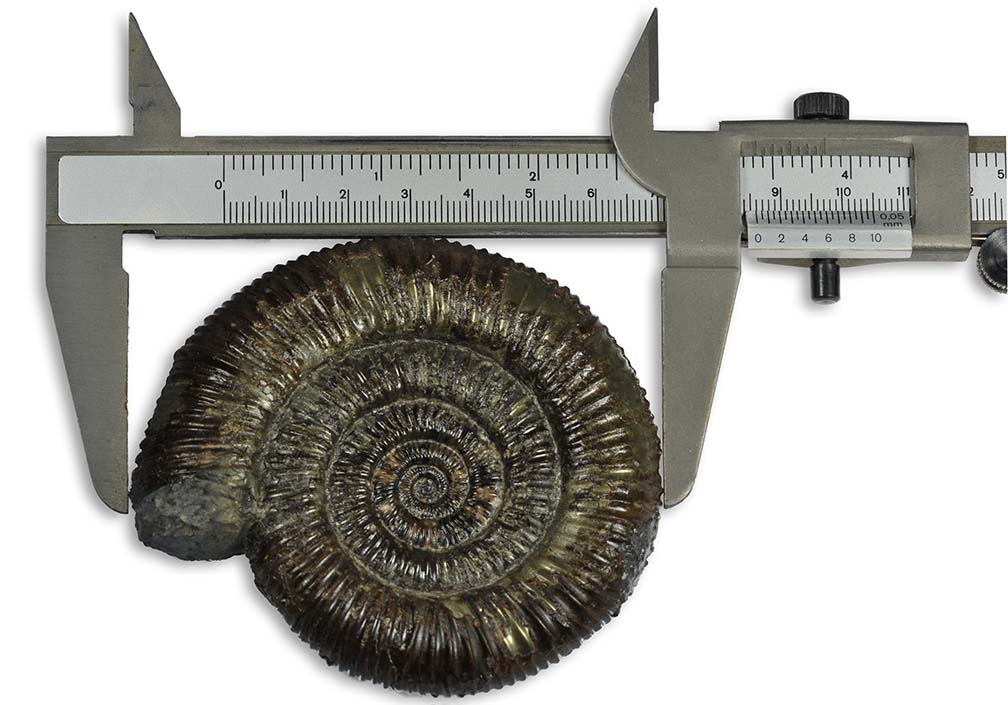
Measuring an ammonite with a pair of callipers

Measuring an ammonite with a pair of callipers

Perception is a wonderful thing – it´s different for everybody. When two persons look at one and the same ammonite they may come to totally different conclusions depending on what light they see it in, what they think they are seeing and maybe also what they want to see…

As I´ve shown you earlier, this even becomes more difficult when you look at the same ammonite species photographed in black & white or in color, or ammonites from different locations preserved differently – e.g. limestone or pyrite, with shell or as an internal mould.
To alleviate this problem of non-objective descriptions of ammonites, several measurements have been developed to provide objective measurements for ammonite shells.
I do not know when this actually started, I´ve seen tables with measurements in SPATH´s Liparoceratidae in 1938, wonderful scatter diagrams of various measurements in HOWARTH´s Amaltheidae and Hildoceratidae monographs from the late 1950s and early 1990s, but I think the german author Dr. Rudolf Schlegelmilch has so far provided the most all-embracing measurements for liassic (and also middle and upper jurassic in later books) ammonites so far in his 1976 publication (and the 1992 second edition)  “Die Ammoniten des süddeutschen Lias” (The ammonites of the south german lias), which is actually very much applicable to liassic ammonites from locations outside of Germany as well. I´m planning to use the types of measurements that are used in this publication for the ammonites pictured in the planned book as well – so I think it is time to explain them a little and maybe also help non-german speaking users of the SCHLEGELMILCH book, who might be struggeling with the german explanations.
For measuring the ammonite, using a vernier, dial or digital caliper is useful, since it helps in the process of taking the measurements, but precision is only needed to full millimeters.
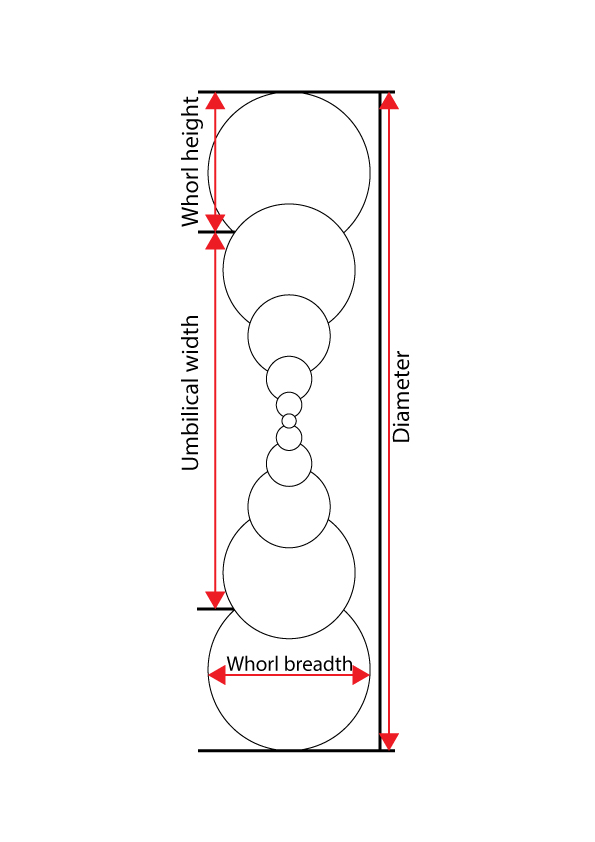
First a picture showing the simple measurements :
Ammonite measurements

Ammonite measurements

  • Shell diameter (d – Schlegelmilch, D – Howarth) :
    It is important to take a set measurements at as close to the same diameter as possible, since
    they may vary with diameter, i.e. an ammonite´s shell can have another whorl height or width
    in an earlier stage of life than an adult ammonite.
    When giving numbers for all of the following measurements it is thus always necessary to
    also quote the diameter at which they were taken.
  • Umbilical width (n – Schlegelmilch, U – Howarth)
  • Whorl height (h – Schlegelmilch, Wh – Howarth)
  • Whorl breadth (b – Schlegelmilch, Wb – Howarth)
  • Rib count  (Z – Schlegelmilch) – Ribs per whorl at a given diameter

For comparing ammonite shells, it has proven useful to create relative, compound measurements :

  • Relative umbilical width (N – Schlegelmilch) : Umbilical width divided by diameter (N = n/d = U/D)
    A larger umbilicus would have a large N, like the quite evolute Dactylioceras commune (like the one shown above) which
    has an N between 54 and 62 %, whereas a much more involute ammonite like an Oxynoticeras exhibits an N of only 14 % at 7 cm.
  • Relative whorl height (H in the Schlegelmilch book) : Whorl height divided by diameter (H = h/d = Wh/D)
    H is a factor in how many whorls there are in a shell, when you look back at the post describing the difference between
    Gagaticeras  and Androgynoceras, I noted that there are more whorls for the same diameter in Gagaticeras and you see it in the numbers :
    Gagaticeras has a H of between 23 and 26 %  , while Androgynoceras is higher at around 30 %
  • Relative whorl section (Q in the Schlegelmilch book) : Whorl height divided by whorl width (Q = h/b = Wh/Wb)
    A large number for Q would describe an ammonite with high, slender whorls like an Amaltheus stokesi, for which Schlegelmilch
    notes a Q of 2.3 (at all sizes), whereas a low Q would describe an ammonite with whorls broader than high, usually of a coronate shell form
    like a Catacoeloceras crassum for which Schlegelmilch quotes a Q of 0.7 (at 7.2 cm diameter ;-))
When you collect a lot of ammonites of the same species, all sorts of statistical analysis becomes possible with these measurements
(as long as you´ve got a large enough sample size…), and this allows you to not only calculate variability of the species within a population,
but also show species differences independant from the perception of an individual.
AndyS

A Yorkshire holiday and Be safe…

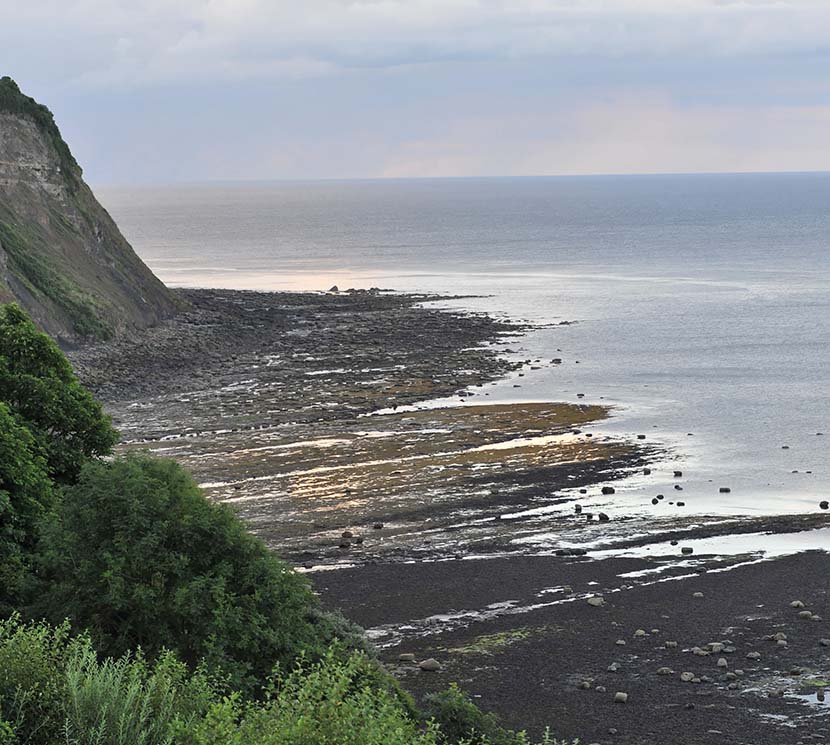
Bay Ness, Robin Hoods Bay, in the evening light at low tide

Bay Ness, Robin Hoods Bay, in the evening light at low tide

You might have noticed the rate of my posts going down in the last couple of weeks – simple reason : I was on holiday, on the Yorkshire coast, collecting and photographing ammonites.
On the collecting side, it  was hard work but some of the more remote locations I visited proved to be relatively productive – at least better than I had feared during this smooth-sea summer time. Nothing obviously being a fossil remains lying on the beach for long these days, accumulations of the so-called “cannon ball” nodules mostly containing Eleganticeras ammonites that we experienced during our first visits in the late 1980s are a thing of the past. Nowadays you need to look more closely, be at the right spot at the right time (after smaller or larger cliff falls have occurred) and be persistent, re-visit often to be there when large tides rework falls or the accumulated cliff debris on the beach.

On a more sad and earnest note, I guess tragic accidents like the one a couple of weeks ago at Burton Bradstock, Dorset,  where a young woman was killed by a huge rockfall, can happen on the Yorkshire coast as well – I have seen the craters in the shingle produced by freshly fallen large sandstone blocks from the very top, so be safe when you walk along those ever crumbling cliffs.
And if some bloke with a beard did remind you to stop your kids hammering at the foot of the cliff, that was probably me…

On the photographing side, it was most interesting – I was given the opportunity to photograph a lot of ammonites where offhand I did not have a clue as to their species, did not know that they existed in such sizes or took my breath away due to their rarity, preservation and preparation. A big “Thankyou !” to all who helped  so far shortening the “wants lists”, you know who you are, I will certainly be able to scratch out a few species off the list, once I´ve properly identified them…
Looking back at the pictures I´ve made during the holiday, I think I can say that my light “on holiday” photography setup (which I will show you in due course) did work, even in the sale room of a well-known Whitby fossil shop…
Thanks also to all old friends who came to join me again in my collecting trips, it is so much more fun to collect with you out there than alone, and thanks also to new friends who I met first time in person, it was a great pleasure to get to know you !
You might also have noticed that I have updated the earlier “Rare and re-bedded” post with some new pictures and text – I did have the ammonite sent to our holiday location, the picture shown in the post previously was by kind permission of the seller of the ammonite – thanks again, Daniel !
And also, what you might rightfully be waiting for, here are a few pictures of “teasers” – unprepped ammonites I took with me this time and a few I left behind…
I chose these especially to show you that ammonites when freshly found very, very rarely look as I´ve shown you in some of my previous posts – a lot of prep work is necessary to make them presentable. I will add pictures in their prepped state and possibly some prep photos once they´re ready…
AndyS

Rare and re-bedded

Phymatoceras rude, 1.4 cm

Phymatoceras rude, 1.4 cm

This wee little 1.4 cm diameter ammonite that came off an eBay auction is a big rarity both in terms of species and in terms of where it was found : Port Mulgrave.

The species isthe ultra-rare Phymatoceras rude (hurray, another species from my “wants list” down !), and it usually comes from the striatulum subzone of the upper lias, the Peak Mudstone member at Ravenscar, where the beds were protected by the downthrow of the Peak Fault from the erosion that everywhere else at the end of the upper toarcian eroded a lot of the uppermost toarcian.
Now wait, you will say, if these beds were eroded everywhere else, then how come this ammonite can be found at Port Mulgrave ?
There are two possible theories (and I think I can trust the data given by the seller, who wasn´t even selling it as a Phymatoceras, so that excludes the third option that the seller tried to make a bit of extra money by selling a rare ammonite that comes from somewhere else…) :
  1. When you look closely at the ammonite, you see a rusty brown sandy substance in the umbilicus.
    I think this is middle jurassic sandstone, and that the ammonite was naturally eroded from the striatulum subzone and then re-bedded when the aalenian sandstone was sedimented. I have seen small badly eroded fragments of ammonites in these sandstones before, but never a recognizable ammonite.
    I think somebody even told me about a nautilus from the sandstones as well…
  2. Somebody found this ammonite at Ravenscar and lost it at Port Mulgrave. Much less interesting…
I like theory 1 best, what do you think ?
AndyS
P.S.: If you are the seller of this ammonite : I know you might think that the sales price was a little low now that you´ve read this.
Console yourself with the tought that you´ve earned yourself a copy of the book once it´s ready !
Edit 09.08.2012 :
I’ve updated this post with a new set of pictures of the Phymatoceras and during our holiday in Yorkshire these last 2 weeks I’ve made of few pictures “on location” that provide some evidence for my theory number 1 :
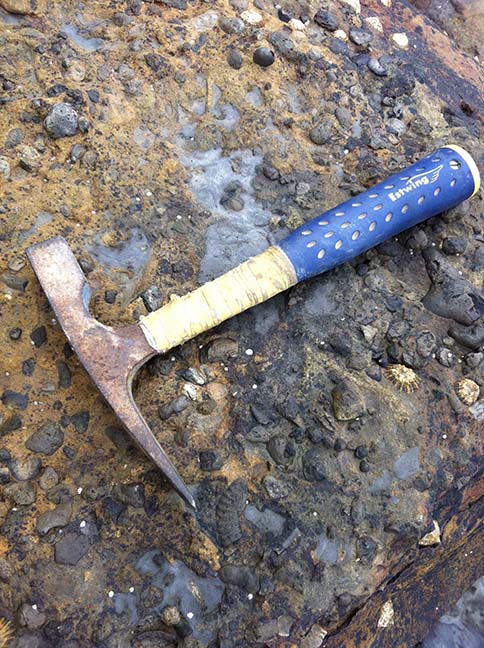
A large aalenian sandstone block with a re-bedded layer of toarcian pebbles, including what looks like a rounded fragment of an upper toarcian Grammoceras !
I’ve looked at many of these blocks during my last collection trip and almost every one of them showed some ammonite fragments !
Aalenian sandstone block with reworked pebble layer, the tip of the hammer pointing to a Grammoceras fragment

Aalenian sandstone block with reworked pebble layer, the tip of the hammer pointing to a Grammoceras fragment

A view through the chambers or Translucent ammonites

On the Yorkshire coast, most ammonites are most usually preserved mud-infilled or pyritized. Calcite preservation of a significant part of the whorls is relatively rare, but does occur occasionally, in my experience for example with

  • Psiloceras
  • Arnioceras
  • Euagassiceras
  • Pleuroceras
  • Eleganticeras
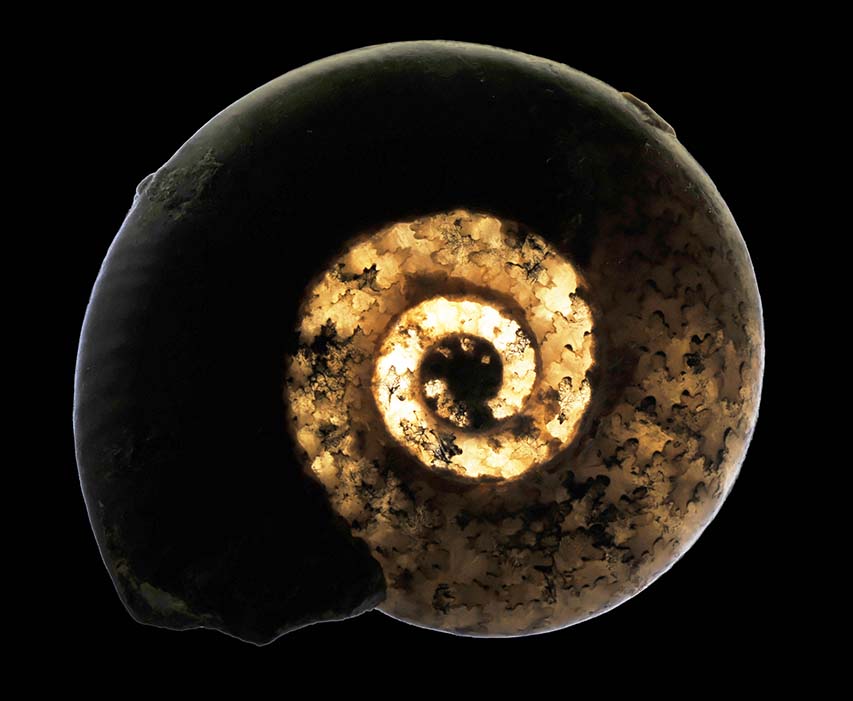
There are rare calcite preserved ammonites where the calcite is so translucent that you can almost look through it – I´d like to show you 2 examples :
The first one is a Psiloceras erugatum from the glacial drift (more on the lower lias ammonites from the glacial drift later) :
Psiloceras erugatum, 3 cm

Psiloceras erugatum, 3 cm

I photographed it against the light on my light table and pulled up the contrast in Photoshop to maximum to show the most of the translucent chambers.
The second is an Eleganticeras elegantulum that you might have seen earlier in one of my Christmas postings on the UKGE forum,
the resemblance of the sutures with Christmas trees was just too tempting…
Eleganticeras elegantulum, width of ammonite 4 cm

Eleganticeras elegantulum, width of ammonite 4 cm

With this one I did a little HDR setup, photographing it with a number of exposure settings and combined the pictures with a software later to capture the maximum dynamic range.
Of course beside the right preservation you also have to prep the ammonite completely free of matrix to see the light shine through – with the two examples shown I was lucky with the Psiloceras, it “jumped” off a multi block matrix free, the Eleganticeras was a lot more work involving air pen, diamond cutter and air abrader to remove all the matrix surrounding it without braking the fragile calcite inner mould.
AndyS

Amaltheidae – One of my favourite ammonite families

Amaltheus stokesi, completely septate, 13 cm

Amaltheus stokesi, completely septate, 13 cm

It must be the beautiful braided keel that most of the members of the family Amaltheidae show that makes it a favourite amongst collectors.
The Amaltheidae family of ammonites includes the genera
  • Amaltheus, with it´s subgenus Pseudoamaltheus
  • Amauroceras, which we´ve already looked at in an earlier post
  • Pleuroceras
Amaltheus (Pseudoamaltheus) is supposed to occur in Yorkshire. I think I´ve seen a badly preserved, flattened one on a crumbling block at Hawsker once, but I´m not sure since large Amaltheus margaritatus can also sometimes show sections with spiral ornamentation. But I´ve never seen one in a collection – If you have one from Yorkshire – let me know !
We´ll deal with the Pleuroceras genus later, so this article will be about the Amaltheus genus.
In the middle lias of the Yorkshire coast, Amaltheus is not particularly rare, although nice specimen can be hard to come by. As with many Yorkshire ammonites from the various beds of the lias, the best preserved Amaltheus ammonites come from nodules.
In the order of (perceived, ascending) rarity of occurrence the species are :
  • Amaltheus stokesi
  • Amaltheus wertheri
  • Amaltheus subnodosus
  • Amaltheus striatus
  • Amaltheus bifurcus
  • Amaltheus margaritatus
  • Amaltheus laevigatus
  • Amaltheus gibbosus
  • Amaltheus gloriosus
  • Amaltheus reticularis
This order of course is just perception, not based on any well founded statistics. Of the 3 first species I have more than 10 specimen in my collection, of the next group of 3 species up to 5 specimen in my collection, the last group of 4 species I have only one or none. This might give you some idea about chances of finding them…
The first one, Amaltheus stokesi, is also the largest, I have found specimen up to 22 cm / 9″.
The shown specimen is almost complete including the body chamber, there seems to be a predetermined breaking point (when eroding) between body chamber and phragmocone, because most specimen are found as just the phragmocone. It does often occur together with A. wertheri and A. bifurcus.
Amaltheus stokesi, almost complete specimen, 20 cm

Amaltheus stokesi, almost complete specimen, 20 cm

Amaltheus  wertheri in constrast is one of the smaller Amaltheus species, I´ve never seen specimen exceed 4 cm. It’s an almost smooth species with just a slight crenelation of the keel and a very pronounced constriction at the aperture.
Comparison of small Amaltheus : A. bifurcus (left), A. wertheri (top), A. stokesi (right), all approx. 2.5-3 cm

Comparison of small Amaltheus : A. bifurcus (left), A. wertheri (top), A. stokesi (right), all approx. 2.5-3 cm

In the subnodosus subzone the species A. subnodosus is the naming index species. it’s got an inner whorl with strong ribs, each crowned with a little tubercle.  Ribs stay strong on larger whorls, while tubercles fade away at around 2 to 3 cm. Strong keel.
Amaltheus subnodosus : Side view, keel view, aperture view (from left)

Amaltheus subnodosus : Side view, keel view, aperture view (from left)

Amaltheus striatus starts similar to A. subnodosus, ribs & tubercles on the inner whorls are not as strong and fade away until at around 2-3 cm the shell becomes almost smooth apart from fine shallow ribs. Strong keel.
Amaltheus striatus, 4 cm

Amaltheus striatus, 4 cm

Amaltheus bifurcus is a rarer Amaltheid from the stokesi subzone, occurring together with A. stokesi and A. wertheri. Similar to A. stokesi, but stronger ribbing at similar sizes, thicker whorls. Usually specimen do not get much larger than 6-8 cm, I do have a very eroded (doubtful) specimen at about 10 cm.
Amaltheus bifurcus, 6 cm, completely septate

Amaltheus bifurcus, 6 cm, completely septate

Amaltheus margaritatus is the index fossil of the margaritatus subzone. It does not overlap with A. stokesi, is seen as the direct descendant from A. stokesi and can grow to similar sizes. The more differentiated keel is the main difference between A. margaritatus and A. stokesi, but since the species do not overlap and the rocks they´re found in in Yorkshire are rather distinctive (ironstone nodules = A. margaritatus, grey limestone nodules = A. stokesi), mixing up of the two species ist almost impossible.
It is often found together with A. subnodosus and A. striatus.
Large A. margaritatus 7cm, A. striatus (below) 3.5 cm, A. subnodosus (left) 4 cm

Large A. margaritatus 7cm, A. striatus (below) 3.5 cm, A. subnodosus (left) 4 cm

Amaltheus laevigatus is almost smooth on the inner whorl and develops fine ribbing after about 1 cm.
Rather rare, I’ve found only 1 specimen in more than 20 years.
Amaltheus laevigatus, 2.5 cm, not a replica !

Amaltheus laevigatus, 2.5 cm, not a replica !

Amaltheus gibbosus  is very rare in Yorkshire – I only have a specimen that I purchased from M. Marshall / M. Forster that came from Staithes.

Amaltheus gibbosus, 3 + 3.5 cm

Amaltheus gibbosus, 3 + 3.5 cm

Both Amaltheus gloriosus and Amaltheus reticularis are apparently extremely rare (or I have not been looking in the right places) – I have not found a specimen of these.
I do have a replica Amaltheus reticularis that I´ve shown you in a previous post.
As a bonus (this is my 20th post !) here´s another picture of a combination of the 3 stokesi subzone Amaltheus :
Large A. stokesi 14 cm, 2 small A. wertheri 2 cm, A. bifurcus in aperture 5 cm

Large A. stokesi 14 cm, 2 small A. wertheri 2 cm, A. bifurcus in aperture 5 cm

AndyS

Old beliefs proven wrong or Young and Old Oxynoticeras

Oxynoticeras simpsoni, 9 / 5 / 3.5 / 2.5 cm

Oxynoticeras simpsoni, 9 / 5 / 3.5 / 2.5 cm

You might have wondered why I called the Oxynoticeras in one of the last posts Oxynoticeras simpsoni and not Oxynoticeras oxynotum. I did actually have that one labeled as O. oxynotum originally, more or less assuming that this was the more common species and not looking for the differences. I had only the large Oxynoticeras where you could not overlook it’s typical O. simpsoni characteristics labeled as such. So when I looked through my collection, I actually found that I had only one potential O. oxynotum, all the other ones were O. simpsoni, just different growth stages !

This picture shows the O. cf. oxynotum , found in 1990, a lucky split, inner whorls as they could be prepped then (with a prep needle).

Oxynoticeras cf. oxynotum, 3.5 cm, 1990 style prep

Oxynoticeras cf. oxynotum, 3.5 cm, 1990 style prep

Today I gave it a little re-prep with the air abrader, just a 5 min job.
Oxynoticeras cf. oxynotum, 3.5 cm, re-prepped today

Oxynoticeras cf. oxynotum, 3.5 cm, re-prepped today

Here is a similar sized Oxynoticeras simpsoni :
Oxynoticeras simpsoni, 3.5 cm

Oxynoticeras simpsoni, 3.5 cm

So here are the main differences between the species : O. oxynotum has a smaller umbilicus at larger sizes, the whorls do not get as thick, the whorl section is more oval with a sharp keel,
there is a bit of a soft wave-like ribbing that almost vanishes at the point where the ribs bend forward towards the keel,  while O. simpsoni has a larger umbilicus, thicker whorls, and the whorl section thins out towards the venter, making it more lanceolate. O. simpsoni has very fine ribbing that continues towards the keel and can produce a crenelated keel. In comparable beds around the world, Oxynoticeras seems to be more common without shell, e.g. pyritized. I wonder if the authors describing the different species ever saw them with shell ?
At small sizes, with the shell on, they´re almost identical.
This is a “classical” larger Oxynoticeras simpsoni, 9 cm, an inner whorl of a larger, eroded specimen, the largest I have with almost complete shell on :
Oxynoticeras simpsoni, 9 cm

Oxynoticeras simpsoni, 9 cm

Both O. oxynotum and O. simpsoni apparently get very large : HOWARTH 2002 describes specimen between 25 and 40 cm !
As usual: If you do have a large specimen like that, let me know !
I have a small Oxynoticeras specimen with a crenelated keel – SCHLEGELMILCH lists this as a characteristic of another 2-3 cm small species O. bucki, which HOWARTH 2002 later lists as a synonym of O. simpsoni – I tend to agree with that, allthough since this one has its complete shell preserved, the other characteristic of O. bucki, as SCHLEGELMILCH describes it – a very simple suture – cannot be seen.
Oxynoticeras "bucki", 2 cm

Oxynoticeras “bucki”, 2 cm

AndyS

Asteroceras blakei or The first description

This is an Asteroceras blakei SPATH, 1925 from Robin Hoods Bay, found by Keeley and Adrian on the 20th of April, 2011 (guess what, my little red book told me that…).
They entrusted this 10 cm ammonite to me for the preparation using my air abrader. After securing the remaining shell with a bit of liquid super glue, to stop it from flying away in the air stream (it easily does that by the way) , I prepped it and it came out like this.
Asteroceras blakei SPATH, 1925, 10 cm

Asteroceras blakei SPATH, 1925, 10 cm

But this is not all that this little story is about, it´s more about finding out more about Asteroceras blakei. 
I usually at least try to take a look at the original description of the author. As you can see from the name, the original describer of this species, Leonard Frank Spath, did name this ammonite in 1925.
In HOWARTH 2002 the ammonite was pictured and full details were given for the original describer and the year, a list of synonyms (Asteroceras marstonense SPATH is one), some museum references, and, in the references the name of the publication where SPATH described the ammonite :
“Notes on Yorkshire ammonites. The Naturalist, Hull, 1925”. The Naturalist, as I found out, is the periodical publication of the West-Riding Consolidated Naturalists’ Society and, later, the  Yorkshire Naturalists’ Union.  Some volumes (between 1865 and 1921) can be found at Archive.org :
They´re delightful reading, most is about fungi, lichen, spiders, birds, etc. but sometimes there is something about geology or fossils. If you open one of the volumes in Acrobat reader and search for “ammonite”,  in the 1921 volume for example you´ll find some not so pleased remarks on BUCKMAN´s then new nomenclature in his “Yorkshire type ammonites” or the prohibitive cost of printing for some of his volumes, in the 1909 volume a short arcticle about “The ammonites called A. serpentinus”, some species of the Harpoceras genus,  including a picture of the giant Harpoceras (then called H. mulgravium) that is now exhibited in Whitby museum. But no luck with the 1925 volume…
I sent out severall calls of help to the various forums I visit, but first to no avail. I had almost given up, when after almost 5 months later out of the blue I received a note from Dr. Rene Hoffmann, from the Ruhr University at Bochum, sending me copies of the two pages describing Asteroceras blakei – thanks again for that !
So here is that first picture of Asteroceras blakei SPATH, 1925 :
Asteroceras blakei, the original picture from "The Naturalist", 1925

Asteroceras blakei, the original picture from “The Naturalist”, 1925

But that´s almost all that SPATH writes about this new species – I must admit I was somewhat underwhelmed for all the trouble it took to find this description !
Thanks of course to Keeley and Adrian, for letting me borrow, prep & photograph the ammonite !
AndyS