Side by side or Vive la différence !

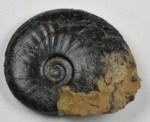
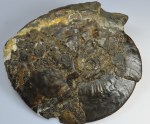
Somebody recently asked me about the difference between Aegoceras(Androgynoceras) and Gagaticeras, two ammonite species frequently found around Robin Hoods Bay.
This is what I´ve come up with :

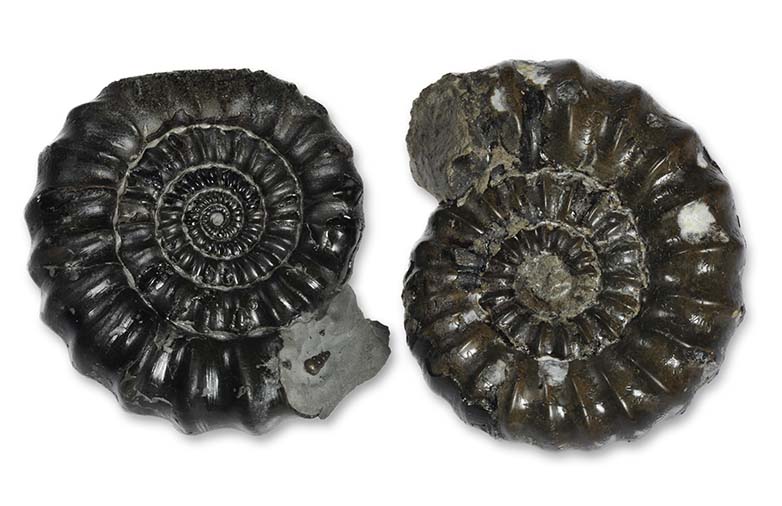
Gagaticeras (left) and Aegoceras(Androgynoceras) (right) side by side

 The ammonites shown are approximately same sized, about 3.5 cm in diameter.
  • Whorl growth more rapid on A.(Androgynoceras), fewer whorls for same size
  • While their whorl section is similar in small sizes (round) , due to more rapid growth in whorl height,  the A.(Androgynoceras) has a more rectangular whorl section at greater sizes.
  • Maximum size for Gagaticeras is about 2″ / 5 cm; A.(Androgynoceras) can grow to more than double the size
  • With most species of Gagaticeras you have at least the hint of a keel, A.(Androgynoceras) has none
  • In terms of preservation, the black shell of Gagaticeras(Gagat is the german name for jet, hence the name ?) is a giveaway, as are small associated gastropods like shown in
    the aperture of the Gagaticeras.
  • Gagaticeras occurs in nodules in softer dark silty shale, sometimes as pyritized outer whorls but very rarely as flattened 2D shells
  • A.(Androgynoceras) occurs in grey nodules with a higher limestone content, but can be found flattened in the shales as well, where nodule buildup did not occur
This is where a photo of them side by side really makes a difference : You can clearly see some of the characteristics that are described in words above (apart from the keel and aperture views.)
And this is where I hope the book will shine : In showing the differences !
AndyS

Opportunity of a lifetime or My wife thinks that was seriously embarrassing…

Collecting fossils on the Yorkshire coast is not like collecting fossils in a quarry that is still being worked  : You cannot rely on the progress of the quarrying so usually you have to make do with what erosion provides and collect from the debris or in the shingle on the beach. In many areas you can since many years no longer dig in situ, because many exposures are protected as an SSSI (Site of Specific Scientific Interest) by British law (for more information please see http://www.sssi.naturalengland.org.uk  ).

Now that in no way makes collecting dull or seriously lowers your chances of success : There is still enough rock naturally crumbling away from the cliffs  (although we fossil collectors always moan about mild winters, lack of north-easterly storms of the truly ferocious sort etc).
But when the opportunity arises to benefit from somebody legally digging in the cliff or reef, you better be there…

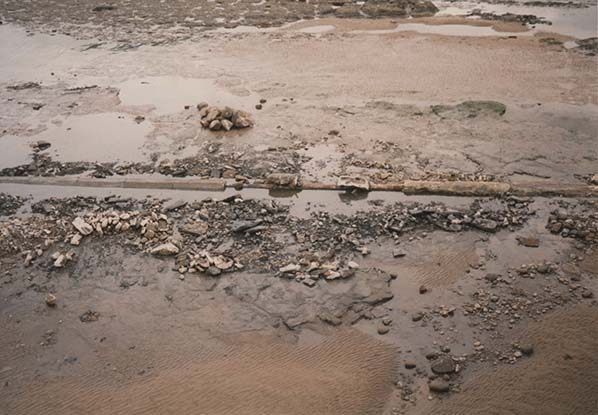
A trench for a new sewage pipe gets dug

This was in April, 1996. A new (err) sewage pipe (yes they still did this then, nowadays all the sewage is being pumped away to a sewage treatment facility) was built out to sea through beds in Robin Hoods Bay. We (2 other friends and myself) just happened to be there (really, I swear, it was just coincidence !).  As we surveyed the rock being dug up, we soon found large, well-preserved examples of Paltechioceras, Eteoderoceras  and other ammonites that we hitherto had never found or never in this size or quality !And now comes the bit that my wife thinks was really, really embarrassing : In our excitement, (she says) we jumped on the freshly dug up rock, like vultures (she says), almost before the digger had dumped it . Well, what can I say, we had a terrific time 🙂

Beds dug up around the trench

Fossil collectors swarm around the digger

I don´t really think that´s us, anyway, the picture is conveniently unsharp…
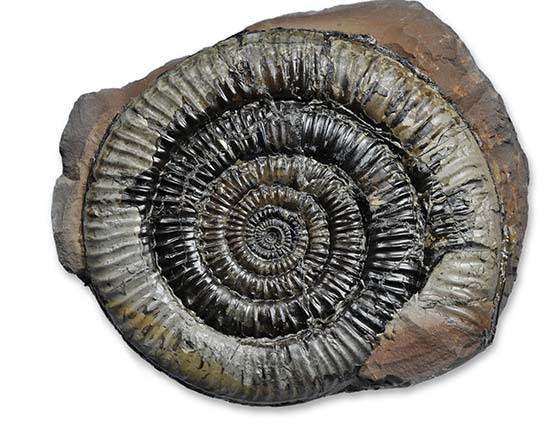
See one result,  a particularly nice 4″ Paltechioceras tardecrescens complete with mouth border here :
Paltechioceras tardecrescens, 10 cm

Paltechioceras tardecrescens, 10 cm

We visited the new trench in the reef again and again during the following days before it was cast with concrete.
Over the years (more than 15 since then), I have found Paltechioceras again, but never as large or complete as this one – it was the opportunity of a lifetime !
AndyS

A as in Amauroceras or A hopeless case ?

You have to start somewhere so why not begin with A ?

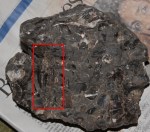
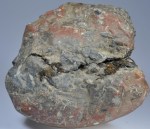
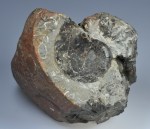
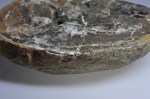
This middle lias (spinatum zone) nodule was found in the shingle on July 17, 2011 around Castle Chamber. The nodule was split in the middle and revealed the typical mix for such a nodule: Plenty of bivalves, a fragmentary, larger Pleuroceras, a smaller Pleuroceras (possibly apyrenum ?) and – looking at it again – a larger Amauroceras, broken straight down the middle, a relatively clean break as well. Larger Amauroceras aren´t all that common, so the nodule was bagged.

I did not look at it again until after May 2012, since it was neither amongst the perceived “highlights” of that holidays´collecting nor did it look easy to prep with the large complex surfaces of the nodule halves that would have to be glued together to make it safe to prep. I did not want to risk damaging the whorls while prepping around it with a pen and I do not have a large stonesaw available. A hopeless case, doomed to end up on the eternal prep backlog ?

So when I looked at it again in May 2012, I put the two halves of the nodule back again to see how they fit – and found they fit so well that I could not break them apart again ! Making a virtue out of necessity, I closed the remaining gap a bit further by gently hammering the two halves together with a hammer and letting a lot of low viscosity super glue run into the crack…

About a week later, I started to prep the ammonite and could soon expose the outer whorl of that 6 cm / 2.5″ Amauroceras lenticulare. I was amazed that you almost have to know where the crack was to see it…

Amauroceras belong to the Amaltheidae family of middle liassic ammonites. There are 2 species to be found on the Yorkshire coast :

  • Amauroceras ferrugineum, a smaller, relatively common species and
  • Amauroceras lenticulare, a larger species.

Apart from the obvious difference in size they differ in …. well I don’t really know that !
Anyone having broken apart a large, well-preserved A. lenticulare to see what the inner whorl looks like ? I haven´t !!!
Looking at the sutures of A. ferrugineum and A lenticulare at approximately same size on page 83 of the Lias SCHLEGELMILCH, they do look different in that A. ferrugineum has a more complex one, while A. lenticulare´s suture is more simple, less “fractal”. But still, you would need to break up your A. lenticulare specimen to find out, those sutures were taken at 7.5 to 8 mm ! In a way, the suture of A. ferrugineum does look more “adult” at this small stage, could this be a sign for a “dwarf” variation ?

The large Amauroceras lenticulare is rarely found in a condition appealing to the collector; the larger shells apparently were quite fragile
and often are only preserved as partials or badly crushed. Furthermore, their thin discus shaped shells are hard to recognize, this may lead to a certain
collection bias so that the smaller Amauroceras ferrugineum appears to be much less rare – not sure if they really are.

AndyS